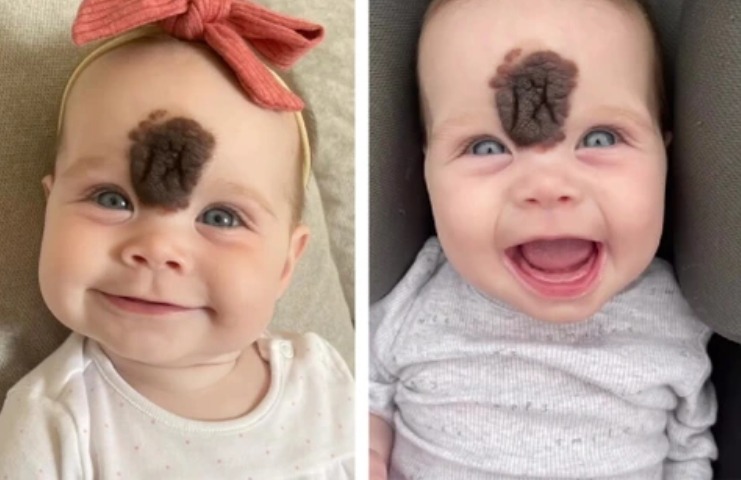
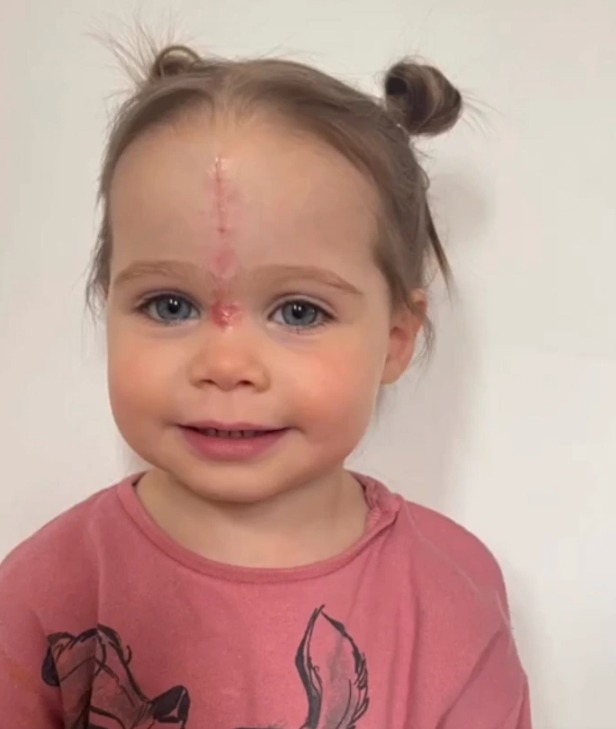
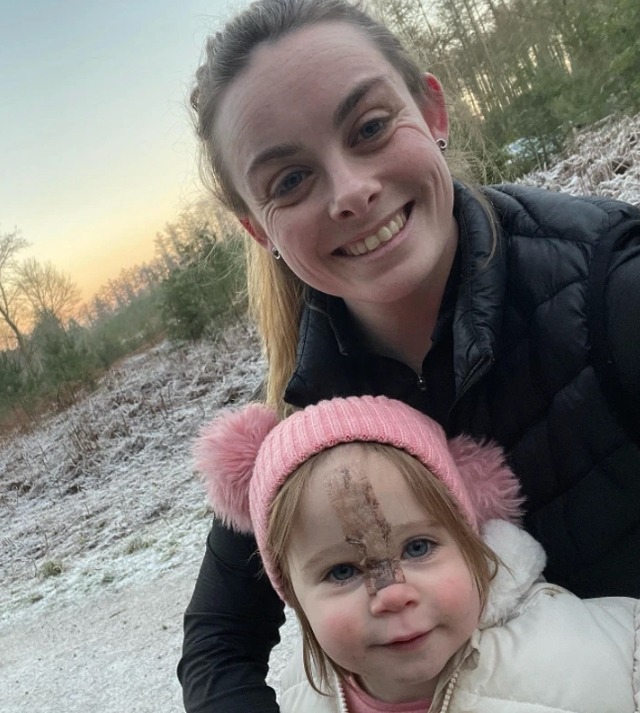
A mother’s determination to address her daughter’s rare birthmark—despite initial resistance from medical professionals—highlights the complexities of parental advocacy in healthcare. Celine Casey’s daughter, Vienna Shaw, was born with a congenital melanocytic nevus (CMN), a birthmark that appears in only one in every 20,000 newborns, prominently located on her forehead. Concerned about the potential social and emotional impact as Vienna grew up, Casey was firm in her decision to have it removed, driven by the desire to prevent her daughter from feeling different and possibly resenting her parents for not acting.
When the family sought medical intervention through the NHS, they were disappointed when doctors categorized the removal surgery as a cosmetic procedure and refused to proceed. This stance sharply contrasted with the parents’ genuine concerns about potential bullying and Vienna’s future emotional well-being. Undeterred, Casey and Vienna’s father, Daniel Brookshaw, decided to raise the necessary funds privately. Their crowdfunding efforts were successful, raising \$52,000 in just 24 hours and eventually reaching their increased goal of \$79,000 to cover hospital expenses.
The parents’ proactive approach led to further disagreements with the medical team. While Casey and Brookshaw pursued surgical removal, the initially consulted surgeon refused, arguing that Vienna should make the decision herself when she was older. A dermatologist agreed, emphasizing that the birthmark posed no health risks and was non-cancerous. Despite these medical opinions, the parents persisted, prioritizing their concerns over Vienna’s social integration and emotional health above the principle of future autonomy.
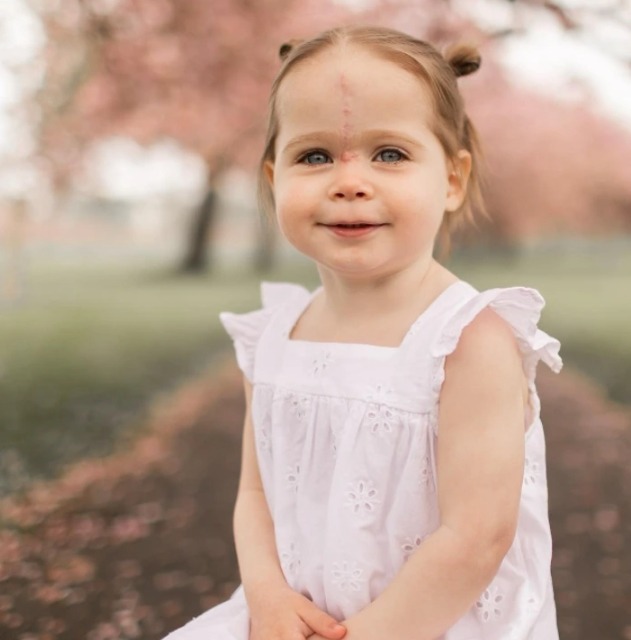
Eventually, Vienna underwent surgery at the age of two, and the birthmark was successfully removed, leaving only a faint scar. Her mother, Celine, has regularly shared updates on Vienna’s recovery on social media, with many followers commenting on the little girl’s beauty. Though the birthmark is gone, the family continues to travel for follow-up appointments to monitor the healing process and determine if further procedures are needed. Now, Vienna enjoys the typical life of a young child.
This case underscores the delicate balance between parental advocacy for a child’s well-being and the medical emphasis on a child’s future autonomy in medical decisions. While Vienna’s parents were motivated by a desire to ensure her social acceptance and emotional health, the medical team emphasized the importance of respecting her future right to make decisions about her own body. The successful removal of the birthmark marks the culmination of her parents’ determined efforts, but the differing perspectives highlight the ethical considerations inherent in situations like this.
Should there be a limit on who can wear a swimsuit? Most would say, “Absolutely not!”—except for my daughter-in-law, Janice, who thinks otherwise.
After a refreshing trip to Miami Beach with my husband, Donald, I felt rejuvenated and loved. One day, I wore a black bikini, and Donald couldn’t stop complimenting me. A little girl even captured our sweet moment in a photo, which I later shared on Facebook.
But then came Janice’s hurtful comment: “Seriously? How can you even think of showing your WRINKLED body in a swimsuit?! You look HORRIBLE!” I was devastated.
Instead of letting it go, I came up with a plan. I suggested hosting a family barbecue. When Janice finally arrived, I took the opportunity to share the photo and explain how it symbolized love that grows with age. I also revealed her cruel comment so everyone could hear it, emphasizing the importance of kindness and reminding them that we all age.
Afterward, Janice apologized, admitting she was wrong. Confronting ageism within the family can be difficult, but wrinkles and gray hair are badges of a life well lived.
Devoted cowgirl Jenny wanted to surprise her husband, Mike, by sending him a photo of herself dressed in full cowgirl attire. Confident that this playful gesture would delight him, she posed in the back of a pickup truck, smiling as she hit the “Send” button.
And she was right—Mike loved the photo and looked at it for quite a while before responding. But as he zoomed in, a small detail caught his attention: Jenny wasn’t wearing her wedding ring. Despite that, she looked stunning. Mike was surprised, as she had never taken off the ring before. At first, he brushed it off, but upon examining the photo more closely, something else stood out: a familiar reflection in the truck window.
It was the reflection of his high school sweetheart, a man she had dated for years. It was clear that he was the one who had taken the photo. Mike decided to confront Jenny. She admitted to running into her ex by chance but insisted it was a coincidence and nothing more.
Unfortunately, Mike couldn’t get past the missing ring and the thought of her ex behind the camera. In the end, he made the difficult decision to file for divorce. That seemingly innocent cowgirl photo unexpectedly shattered the trust in their marriage, leaving Jenny and Mike to face the painful consequences. It was a reminder of how fragile the balance between trust, communication, and understanding can be in a relationship.
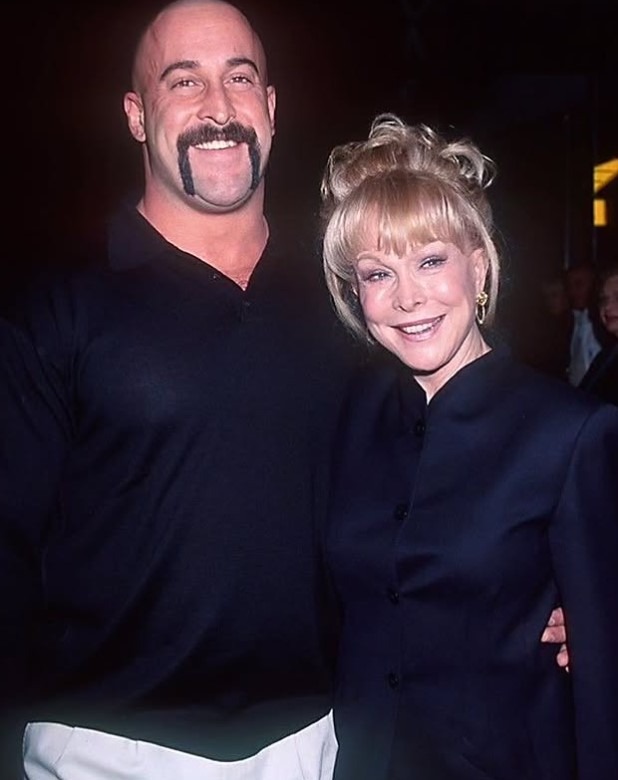
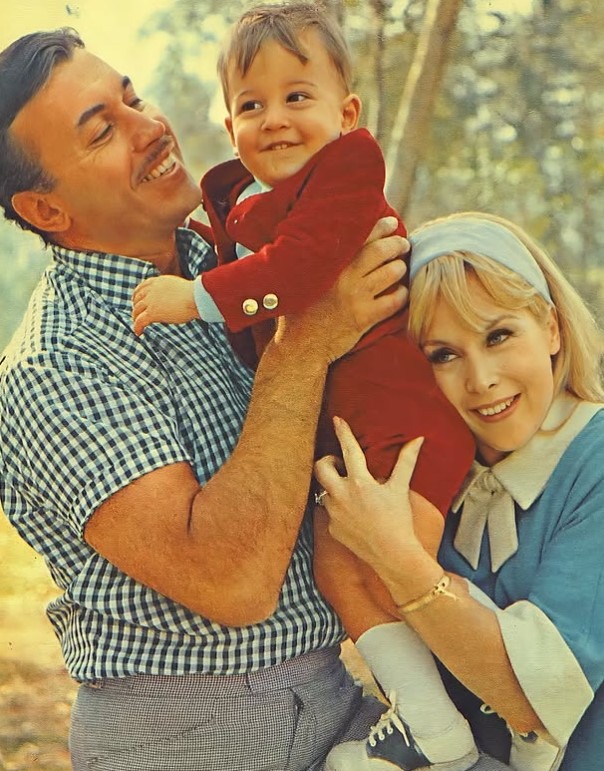
Barbara Eden, the iconic beauty who captured the hearts of the world with her charming portrayal of the genie in I Dream of Jeannie, recently celebrated her 92nd birthday on August 23, 2023. Her career, which began in the mid-1950s, saw her rise to fame as a dazzling blonde admired by millions. Despite her age, she remains a beloved figure in pop culture, but like many Hollywood stars, her life has been anything but perfect. Eden, who became a household name in the 1960s, is no longer the glamorous woman who once lit up the screen, but rather a testament to the passage of time, showcasing both her triumphs and tragedies.
Eden’s rise to fame began in 1956 with appearances in movies and television shows. She later starred alongside Elvis Presley in Flaming Star (1960) and cemented her legacy in 1965 by donning the magical costume of Jeannie. That role would go on to define her, leaving an indelible mark in television history. However, while she was reaching the height of fame, Eden’s personal life was riddled with hardship. Despite her charming on-screen image, her family life was marked by sorrow—especially with the tragic loss of her son, Matthew Ansara, who died of a heroin overdose in 2001.
Her son’s struggles with addiction began when he was just a child, and although Eden tried tirelessly to help him, the battle proved too difficult. Her relationship with Matthew was complex, filled with moments of both hope and heartache. Despite entering rehab multiple times, Matthew’s addiction persisted, and it wasn’t until his tragic death at age 35 that Eden was consumed by grief. The pain of losing a child—especially under such devastating circumstances—cast a shadow over the beauty and elegance that once defined Eden’s public image.
Today, Barbara Eden is no longer the timeless beauty of I Dream of Jeannie, but a woman who has embraced the changes that come with time. Her appearance has inevitably changed with age, but she continues to defy Hollywood’s expectations, where many stars resort to surgery to maintain their youth. While some focus on the lines that have appeared on her face, others find inspiration in her ability to remain true to herself despite the toll of time. Eden, once the epitome of beauty, is now a woman who has experienced both the highs of fame and the depths of personal loss.
Although she has stepped away from her role as Jeannie, Eden still appears on television and in films from time to time. Recently, she took part in Worst Cooks in America: Celebrity Edition and the 2019 holiday movie My Adventures with Santa. Despite her advanced age, Eden has maintained a modest presence, choosing roles that reflect her age and experience. While the world once adored her for her youthful beauty, today Barbara Eden is a symbol of resilience, reminding us that beauty is much more than appearance and that true strength comes from within.
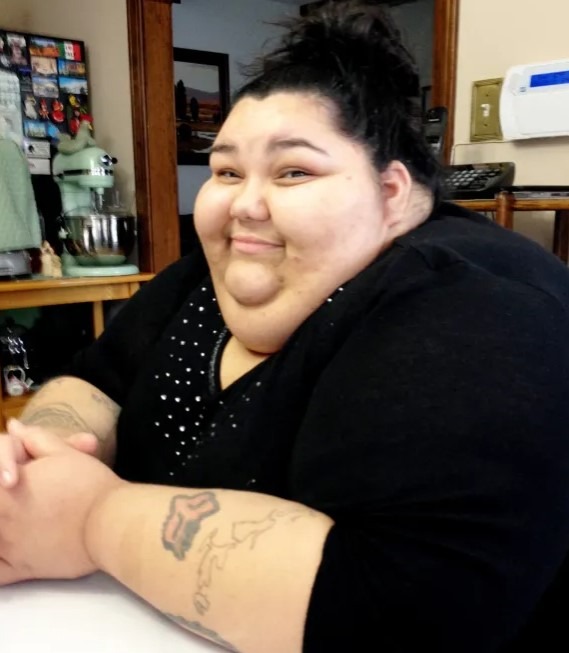
Tanya Santiago, 31 years old, went through an impressive transformation by losing nearly 190 kg after facing a series of personal hardships. At her worst, weighing over 267 kg, everyday tasks were a challenge and she relied on unhealthy eating habits. A tragic miscarriage in 2020 was the turning point that made her realize the serious health risks her weight posed. This tragedy, along with an unhappy marriage, pushed Tanya to make drastic changes to her lifestyle.
Determined to regain her health, Tanya began incorporating physical activity into her routine, starting with walking and swimming. She also revamped her diet, replacing fast food with nutritious homemade meals. Within a year, she lost almost 114 kg, but her health was still in danger. Doctors diagnosed her with fatty liver disease, which could progress to cancer. Realizing the urgency of her situation, Tanya opted to undergo gastric bypass surgery in January 2023—a decision that further accelerated her weight loss.
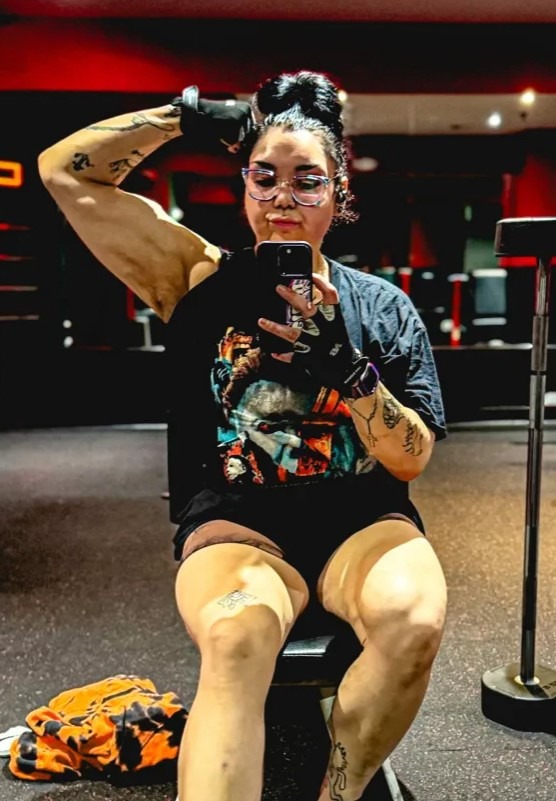
After the surgery, Tanya committed to an intense exercise regimen, training six days a week for two hours a day. Her dedication paid off, and she eventually reached a healthy weight of 76 kg. The transformation was so radical that even her family had trouble recognizing her. One particularly funny moment occurred when her niece walked past her in a shopping mall without realizing she was looking at her own aunt. Beyond the physical changes, Tanya also experienced a boost in mental well-being, gaining confidence and a renewed outlook on life.
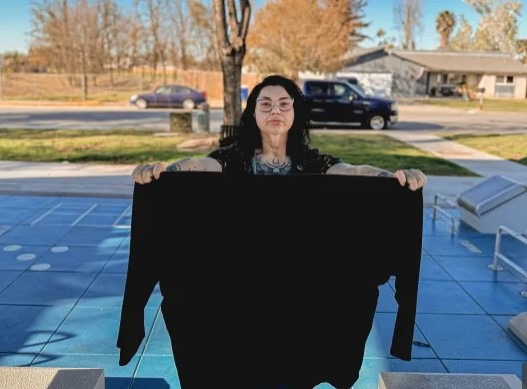
Tanya’s weight loss journey also brought positive changes to her personal life. She found love with her partner, Gabriel, who has supported her from the beginning. As a reminder of how far she’s come, she keeps her old size 7XL clothes—a symbol of her incredible progress. With her newfound confidence and determination, Tanya now dreams of becoming an online coach and bodybuilder, using her experience to inspire others to achieve their health and wellness goals.
Her story is a powerful testament to resilience and perseverance. By overcoming her personal and health struggles, Tanya has transformed her life in ways she never thought possible. Now, she hopes to motivate others to take control of their well-being, showing that with dedication and the right mindset, a drastic change is within anyone’s reach.
Since early morning, heavy snow had been steadily falling—thick and slow, like someone carelessly dumping flour from a shovel in the sky, indifferent to where it landed. A single car crept along a snow-covered country road, a tiny speck in the vast, frozen landscape. Inside, the wipers squeaked rhythmically, snow crunched beneath the tires, and a baby’s occasional sobs broke the stillness.
Igor clutched the steering wheel so tightly his knuckles had gone pale. His eyes were fixed on the barely visible road ahead, obscured by the relentless blizzard. He hadn’t spoken in ten minutes. Beside him, Tatyana sat in tense silence—her shoulders slumped, lips drawn tight, eyes distant and vacant. She looked not just weary, but completely drained. The family had relocated to the village, hoping for a fresh start, a chance for Tatyana to regain her health…
“Maybe we should turn on the radio?” Igor finally broke the silence, not taking his eyes off the road.
“Why?” she answered dully, without turning her head. “To drown out the baby’s crying?”
Igor exhaled loudly.
“It’s starting again…” he whispered under his breath, then added a little louder: “I drive, I try. In this weather, and in your car, which always lets you down…”
“My car?” Tatyana asked bitterly. “Because you spent your money on cigarettes?”
The baby stirred and started crying again. Igor jerked the steering wheel sharply, feeling growing irritation inside.
For illustrative purpose only
“Great. We arrived in the village, started all over again – and you immediately hit me on the head. Maybe it would be better to keep quiet? At least get to the destination in peace…
“Enough. Just… shut up,” Tatyana almost whispered, pressing her forehead to the window. She closed her eyes, and a tear slid down her cheek.
The car skidded a little on the turn, but Igor held it. An old house appeared behind the icy trees – blue, crooked, as if forgotten by time.
“Here is our destination,” he said, stopping at the edge of the field. “We’ve arrived.”
There was no road further – only snowdrifts and off-road.
Tatiana slowly got out of the car, hugging the baby in a blanket. Her steps were uncertain, like those of a person who no longer believes that the ground under her feet is reliable.
She took a couple of steps – and stumbled. The snow was deeper than it seemed. She squealed, fell to her knees, hugging the baby.
— What are you doing… — Igor rushed to her, taking her son from her arms. — Be careful! What’s wrong with you?
— I know how to hold him myself, — he answered irritably, helping his wife to stand up. She walked on silently, with reddened eyes, leaning on her husband.
The house greeted them with silence. The creaking of the steps, the click of the lock, a cold gust of wind — and snow that had to be cleared away with your hands. The key entered the rusty keyhole with difficulty.
— Well, I’ll be… — Igor shook the door, exhaling steam. — Don’t let me down now, you old wreck…
Finally the lock gave in. They entered the darkness.
The smell of mold, dust and dampness hit their noses at once. In the light of the phone, scattered sacks, scraps of rope, and grain were visible. Everything was covered in a gray film of abandonment.
“Oh God…” Tatyana whispered. “Are we going to live here?”
“For now,” Igor answered briefly. “We’ll clean it out, and get used to it little by little…”
He found a broom and a bucket and began to actively clean. Rustling, creaking floorboards, bangs—the sounds were more reminiscent of the noise on a sinking ship. But it worked.
— Let’s make a children’s room, — he said, not stopping cleaning. — This one. The radiators are old, but they work. The walls are intact. The windows are double-glazed.
— And the ceiling? — Tatyana asked doubtfully. — And the mold in the corner?
— We’ll wipe it down, dry it, insulate it. Just hold on, Tanya. For him, for his sake.
She didn’t answer. She just sat down on the sofa, wrapped in her coat.
The room had grown slightly warmer. Though the walls were cracked and peeling, one of them held a picture: the Nutcracker brandishing a sword, encircled by mice. A thought briefly crossed Igor’s mind, but he quickly brushed it aside.
— So much for your protector, Dimon, — he grinned, hammering a nail into the wall. — The Nutcracker is on guard.
Night fell suddenly, as if someone had flicked a switch. Everything around became gray and silent. Only a barely audible sound behind the wall made Tatyana shudder.
– Igor… Did you hear that?
– Probably mice, – he shrugged.
– No, there is someone… whining. Outside.
He listened. And indeed – a thin, drawn-out sound, breaking off every now and then, came from the snowstorm.
– I’ll check now, – he said and went out.
On the porch, in a snowdrift, sat a dog. Dirty brown, with a dark muzzle and eyes full of unspoken pain. She was shaking, her paws tucked in, her tail between her legs.
For illustrative purpose only
– What’s wrong with you? – Igor sat down. – You’ll freeze, stupid.
The dog raised his head. There was confidence in his gaze, as if he had come here and nowhere else.
— Let’s go, — Igor said quietly and motioned for her to come inside.
Lada ran into the house and immediately headed for the nursery. She went up to the crib and froze in her tracks.
—What the hell?! — Tatyana exclaimed in fear. — Take her away immediately! She’s going to the baby!
— Calm down, — Igor tried to convince her. — She’s friendly. Look — she’s barely even breathing. She’s just cold.
— I’m scared. I don’t want her near him, — Tatyana said firmly.
Igor hesitated, but nodded:
— If anything happens, I’ll throw her out. Okay? Give her a chance.
She turned away without a word. That night, she slept fitfully, holding her son tightly in her arms, while the dog lay motionless at the foot of the bed—like a statue, unmoving and unblinking.
Morning arrived bright and brilliant. Sunlight danced across the frosted windowpanes, casting strange, whimsical patterns on the ceiling. A rooster crowed outside—sharp and insistent, as if declaring the start of a new day. The room carried the scent of dampness, cold timber, and something else—foreign and indescribable.
Tatyana was the first to awaken. She rubbed her eyes and noticed an unfamiliar lightness in her chest—for the first time in ages, she wasn’t coughing. She quietly made her way to the nursery. Dima was fast asleep, breathing calmly, and the dog lay beside his bed, stretched out taut, as if on guard.
For illustrative purpose only
“You’re still here …” Tatyana whispered. Her voice was restrained, but something new flashed in her eyes.
The sounds of dishes were heard in the kitchen. Igor was bustling about at the stove, in a sweater and shorts, carefully breaking eggs. The sun was pouring through the windows, and something alive seemed to be beginning to emerge in the house.
“We’re having a celebration today,” he smiled without turning around. “Breakfast! And, look – we now have chicken!”
Tatiana raised an eyebrow.
— Alive?
— Yes, I bought it from my neighbor, Grandpa Misha, across the ravine. And I took some eggs — homemade ones.
She sat down at the table. Lada carefully lay down at her feet, but Tatyana pretended not to notice.
— What did you name her, by the way? — she asked after a pause.
— Lada. In honor of my grandmother. She was quite a kind soul.
— In honor of my grandmother, — Tatyana repeated, frowning slightly. — And when were you going to tell me about it?
— Well… I told you now. Morning, tea, scrambled eggs, family revelations.
She sighed. Snowdrifts crunched outside the window again — someone probably passed by the house.
— Sometimes it seems to me that you live as if you have no one — no wife, no child, — Tatyana said quietly, without raising her eyes. – You make decisions alone, without even consulting me. Not about the chicken, not about the dog… You even gave her a name without me.
– Tanya… – Igor sat down next to her. – You know how exhausted you are. I didn’t want to add to your worries. I tried to do everything myself. Really.
– Tried? – She smiled bitterly. – And the fact that she lay down right next to the crib? Is that also part of your “trying”? Are you not worried at all?
– Yes, – he leaned closer, – I just understand how exhausted you are. The move, illnesses, cold, little… And this dog. Perhaps she is the only one who took us seriously here.
Tatyana did not answer. She only ran her hand through her son’s hair, then slowly stood up, straightening her back with an effort.
– I need to rest. The cough came back again.
Lada followed her with her gaze and followed, silent as a shadow.
The day turned out to be busy: Igor insulated the windows, sealed the cracks, looked for sources of drafts. Quiet music came from the old radio, creating the illusion of coziness. The air was filled with the smells of wood, dust and something else – the house seemed alive, but only beginning to learn how to be a home.
Lada did not leave Dima’s side for a single step. Wherever Igor walked with the child in his arms, there she was – attentive, focused, with an unusually lively look.
— As if she were watching, — he muttered under his breath.
— It’s scary, — Tatyana responded from behind the curtain. — Dogs don’t behave like that. As if she’s waiting for something.
Igor went out onto the porch to smoke. The snow crunched under his feet, the frost tickled his skin. He took out a cigarette — and suddenly heard a rustle behind him. He turned around — Tatyana was standing in the doorway, wrapped in a shawl.
— Again? — his voice was shaking. — You promised to quit.
— Just nerves, — he tried to justify himself. — I can’t change my ways right away.
— You’re a father, — she said firmly. — And I trusted you.
He stubbed out the cigarette and trampled it in the snow. Anger was boiling inside her – at herself, at the village, at this house, at the dog that was looking at her from the darkness almost like a human.
That night, Tatyana woke up with the feeling of someone’s presence – too close, too real. Lada was sitting by the baby’s crib, tense as a string. The fur on the back of her neck was raised.
“Igor, wake up,” she whispered.
He winced, opening his eyes.
“What happened?”
“Look at her. She’s growling.”
Igor approached. Lada wasn’t paying any attention to him – her gaze was directed at the corner of the room. Her ears were pressed back, her teeth bared.
“Lada?” he called cautiously. “Hey… calm down.”
The dog didn’t move.
“Oh, God…,” Tatyana whispered. “What does she see?”
– Maybe you imagined it? – he tried to calm down. – Or it was a mouse. Or it’s nothing to worry about…
– Nothing to worry about?!” she flared up. – She stands there like a sentry and bares her teeth! Is that normal?!”
Igor was at a loss for words. He put his hand on her withers – Lada shuddered slightly, but did not retreat. He carefully led her into the hallway and closed the door.
– If you drive us all crazy, – he whispered to her, – you will spend the night in the barn.
The dog looked at him and followed him – but without tension.
The days flowed in a gray succession: porridge in the morning, a snowstorm outside the window, a child’s cry, Tatyana’s cough… And always nearby – Lada. Part of the house, like the floor or the walls.
Another morning was gloomy. The snow became dirty gray, as if it was losing its meaning. Igor stood by the porch, crumpling a rag in his hands. His eyes stung from lack of sleep, his chest ached dully. He felt that something was wrong in the house. As if the air had thickened, and it was hard to breathe.
In the barn, he noticed something fallen. He went over. A chicken. Dead, mangled. Feathers torn out, neck broken. Large footprints in the snow. Blood.
“Lada…” he whispered.
The dog came out from around the corner. Its tail was down, its muzzle was dirty. There were crimson spots on its fur. It froze. It didn’t growl or squeal. It just looked straight into his eyes.
“What have you done…” Igor exhaled.
Tatyana followed him out.
“What are you doing there?” she asked and saw the carcass. She stepped back. “Is this… her?”
— Looks like it.
— Oh, my God… I told you! And you were protecting her! And now this!
— Maybe it wasn’t her…
— Her face is bloody, Igor! — her voice broke. — She growls at night, watches the child, and now she’s killed a chicken! And what if tomorrow it’s Dima?!
— Tanya…
— Today. Either you take her away, or I’ll do it myself. Do you hear?
She entered the house, slamming the door. A minute later, Igor heard the characteristic sound of a bottle of sleeping pills opening.
He approached Lada and squatted down. She didn’t move.
— What should I do with you? — he whispered. — I don’t know, Lada. Honestly. I don’t know.
The dog didn’t want to get into the car. He pulled, persuaded, got angry, pushed. She resisted. But then, at some point, she gave in. She climbed inside herself.
The road was long and quiet. The engine rumbled, the blizzard obscured the headlights. Snow flew like frames from a film ending tragically. Igor clutched the steering wheel, as if trying to hold on to something important. There was emptiness inside.
He stopped at the bridge. He let go of the Lada and drove away. Without turning around.
When he returned, the house greeted him with silence. Without the dog, it became different. Empty. Cold. As if someone had turned off the lights.
Tatyana was sleeping. Dima was breathing peacefully in his crib.
Igor tried to read, then chop wood, then just sat, staring at the wall.
Rustle.
He shuddered. Listened.
Again. Behind the wall. As if claws were scratching the wood.
He walked around the house. Everything was quiet. He returned.
A rustle again. And a creak.
He went outside. He stood, looking into the night. The snow was falling in thick flakes. He took out his cigarettes. He held them in his hand. Then he crumpled them and threw them into the snow.
And suddenly something brown flashed to the right.
“Lada?” he said out loud.
A dog flew out of the darkness. Covered in snow, disheveled. Straight to the house. Without stopping, without looking back. She ran through the door, hitting her shoulder.
“Damn it!” Igor shouted and rushed after her.
There was barking in the house. Sharp, furious. From the nursery.
– Tanya! Wake up!
Tatiana came out as if in a dream.
– What’s going on?
– Lada. In the nursery.
– What?!
They burst into the room.
The bed was overturned. The sheet was thrown off. Lada was standing, shaking, her mouth was open – something was sticking out of it.
A long, gray, nasty tail.
She shook her head – and a rat fell out onto the floor. A huge one.
Tatiana screamed.
– Lord… Lord, protect us…
Lada approached the child, sniffed, licked her nose and lay down next to him, turning her head towards the door – as if she was still on guard.
Igor approached as if in a fog. Slowly bent down, took the dead rat by the tail. He lifted it to the light – the animal was the size of a large cat. Its fur was matted, its teeth were yellowish.
“She was protecting him all this time…” Tatyana whispered, looking at Lada. “Igor nodded. His voice had treacherously disappeared.
Tatiana knelt down in front of the dog, clasped its head in her palms, pressed her forehead to its muzzle:
“Forgive us… Forgive me. If it weren’t for you…”
Tears rolled down her cheeks. Lada took a deep breath and laid her head on the floor. Calmly. As if she knew: it was all over.
“It’s grandma…” Tatyana whispered. “She came to us through her. From the other world.
Igor went out into the yard. He stood there for a long time, clutching the stiff body in his hand. Then he threw it into the snow, buried it with his foot. He returned to the house. He sat down next to his wife and put his hand on Lada’s back.
“Thank you,” he said. “Forgive us, fools.”
The room was filled with silence. Only Dima was peacefully snoring in his crib, and the blizzard outside was gradually dying down.
Lada lay quietly, her eyes closed, her breathing even. There was no longer any anxiety or tension in them – only fatigue and quiet, silent loyalty.
Tatiana slowly knelt down in front of her and began to stroke her neck, her cheeks, her soft ears. Her hands were shaking, her face was pale, her lips were pressed into a thin line.
“Forgive me…” she whispered again. “If it weren’t for you… Dima might not have existed. And we… We would have simply fallen apart.
The dog didn’t move, only looked up – with some kind of almost human sadness and dignity. As if she was saying: “I understand everything. I forgive you.”
Igor stood by the wall, pressing his shoulders against the wallpaper. In his hands was a blanket, under which lay the already dead animal. He could not look at it. He simply could not.
He went out, went down to the yard, took a shovel. Silently, with effort, in wet boots, he dug a hole in the frozen ground. He threw the rat in there, quickly buried it. He leveled the snow, as if erasing the tracks.
Then he returned. He did not look at Lada.
The morning began with silence. Dima slept peacefully, even smiling in his sleep. Lada lay in the corner, as if she had never left.
The kitchen smelled of semolina porridge. Tatyana stood by the stove, wrapped in a long robe, her hair neatly gathered. For the first time in many days – without a shadow of fear in her eyes.
“I want her to stay,” she said without turning around.
Igor was silent, sitting at the table. Lada came up and laid her head on his lap.
He stroked her mechanically.
“That’s true,” he said quietly. “Now she’s like family to us. Like a guardian angel.”
From that day on, everything became different. The house came alive. The silence stopped oppressing. The sun peeked into the windows more often. Dima grew, Lada grew with him – not in body, but in heart.
One day, three teenagers from a neighboring farm showed up. They were hooligans, running around the yard, knocking on the windows. Igor was in the barn, Tatyana was in the house. And Lada was on the porch.
She came out and stood in front of them. She didn’t growl, didn’t bark. She just looked straight into their eyes. So that they froze, exchanged glances – and ran away without a word. No one dared to approach without asking.
A month later, the village began to thaw. The first shoots blossomed, the air became softer, the evenings longer. Igor no longer lit a cigarette. It seemed that the craving itself had disappeared.
“Sometimes I think,” he said one evening, sitting by the stove, “if I hadn’t let her in then… or hadn’t returned in time…” He paused. “I almost lost everything.”
Tatiana put her hand on his shoulder.
“But now we know who we are to each other. And to her.”
Almost two years passed. Spring returned to their small village house again. Together with it – a new chapter in life.
A diaper was drying on the porch. The house smelled of milk and chamomile. Tatiana was lying on the bed – pale, but happy. Next to him was a newborn girl, with dark eyelashes and a strong, pink fist.
Dima was running around the yard in old felt boots, Lada was next to him, not lagging behind a single step.
A car stopped at the gate. Igor and his mother got out of it – cheerful as always, with suitcases and packages.
Tatiana looked out the window and laughed.
A red carpet was spread out in front of the porch on the snow – an old carpet. And on it, as if at a parade, stood Igor, Dima and Lada.
“You’re such a joker, Igor,” Tatiana smiled.
He came up to her and carefully picked her up.
“I promised. The second one is a princess. For her – carpets.”
Slowly, solemnly, as if at a royal reception, he walked along the carpet. Lada walked alongside him, as if she knew how important this moment was.
The frigid light of the fluorescent lamps projected grayish hues across Terminal D at Otopeni Airport. Officer Andre examined the throng with alertness that came from years of expertise. Luna, an imposing German Shepherd with a shining coat and intelligent eyes, walked alongside him. For three years, they had been an unbreakable unit. Luna has made no mistakes in all of her life.
Andrei’s gaze shifted from face to face, observing gestures, motions, and reactions. He knew the game by heart.
But that night, something shifted.
For illustrative purpose only
Luna stopped abruptly. Her ears perked up, tail stiffened, and her gaze locked onto a woman pushing a stroller with a baby wrapped in a light blue blanket. The dog’s nostrils flared, sniffing the air with an unusual intensity. Then, without warning, a low and threatening growl rumbled from her throat.
Andrei detected the movement right away. The air appeared to thicken around them, and the terminal cacophony vanished like a dream. The woman, a slender brunette with bulging eyes and a pale face, grasped the pram handle desperately and stammered:
— Get the dog away from my baby!
But Luna disobeyed. For the first time in her career, she did not respond to her handler’s commands. She leaped at the stroller with remarkable speed, ramming her huge paws on the plastic frame. The blue cover peeled away, and what emerged stunned everyone.
There was no newborn underneath the baby blanket. Instead, a thermal bag was tucked between the pillows and securely sealed. Labels in Russian and Chinese were placed on it, along with biological hazard indicators. Shiny canisters could be seen within, emitting a pungent chemical stench.
For illustrative purpose only
Andrei reacted immediately. He grabbed the woman by the arm and drew her aside, while Luna stayed motionless, her gaze fixed on the stroller’s contents. Another officer dashed out to contact the anti-terrorist team.
— What’s this?! Where is the child?! — Andrei yelled as the woman’s eyes filled with tears.
She shook her head and, between sobs, whispered:
– There was no baby. I was advised to get it past security. I’m not sure what’s within.
Within minutes, the area was secured. Emergency reaction teams stormed the terminal, and the suspected containers were handled with caution by protective equipment professionals.
The subsequent investigation aimed to identify an international network trafficking prohibited biological products. According to preliminary investigations, the packages included experimental samples obtained from illegal laboratories in Asia and bound for a clandestine facility in Western Europe. Experts warned that the compounds being transported may have produced a biological disaster if released accidently or intentionally.
The woman had been recruited with promises of easy money. She had no idea what she was carrying but agreed to smuggle a “discreet package” across the border, claiming it was a sleeping child.
For illustrative purpose only
Luna’s story traveled across the country. That nightfall, photographs of the brave dog and Officer Popescu aired on every television channel. People praised the four-legged hero’s bravery, saying she saved a potential large-scale disaster with her amazing instinct.
Andrei moved and later stated:
— Luna wasn’t only a service dog that night. She was the guardian angel of an entire airport, and possibly of Europe.
That night, a simple routine check save thousands of lives.
Three women arrive at the gates of Heaven, where St. Peter greets them with a simple rule:
“Welcome to heaven! There’s just one thing—DO NOT step on the ducks!”
As they enter, they realize the place is *full* of ducks. No matter how hard they try, the first woman accidentally steps on one.
QUACK!
St. Peter appears immediately, dragging along the ugliest man she’s ever seen.
“Your punishment? Spending eternity chained to this man!”
The second woman is extra careful but still ends up stepping on a duck the next day. St. Peter shows up again, this time with another extremely unattractive man.
“Same rule applies!”
The third woman, now terrified, tiptoes everywhere, determined not to make the same mistake. She spends months avoiding ducks like a pro.
Then one day, St. Peter arrives—this time with the most handsome man she has ever seen. Without a word, he chains them together.
Overjoyed, she turns to the man and says: “I have no idea what I did to deserve this!”
The handsome man sighs and replies: “I don’t know about you, but I stepped on a duck!”
LOL!!
Hope this joke will make you smile! Have a nice day!!
Two ladies swap ‘How I Died’ stories in heaven
I came across this hilarious story and just had to share it! It’s a funny twist on what might happen if two ladies met in heaven and swapped their “how did you get here” stories.
Here’s how it went:
1st woman: Hi! My name is Wanda!
2nd woman: Hi! I’m Sylvia. How’d you die?
1st woman: I froze to death.
2nd woman: How horrible!
1st woman: It wasn’t so bad. After I quit shaking from the cold, I began to get warm & sleepy and finally died a peaceful death. What about you?
2nd woman: I… died of a massive heart attack. I suspected that my husband was cheating, so I came home early to catch him in the act. But instead, I found him all by himself in the den watching TV.
1st woman: So, what happened?
2nd woman: I was so sure there was another woman somewhere that I started looking all over the house. I ran into the attic, searched, and down into the basement. Then I went through every closet and checked under all the beds. I kept this up until I had looked everywhere, and finally, I became so exhausted that I just keeled over with a heart attack and died.
1st woman: Too bad you didn’t look in the freezer—we’d both still be alive!
Remember, laughter is the best medicine, so be sure to send this on to someone whose day you want to brighten!
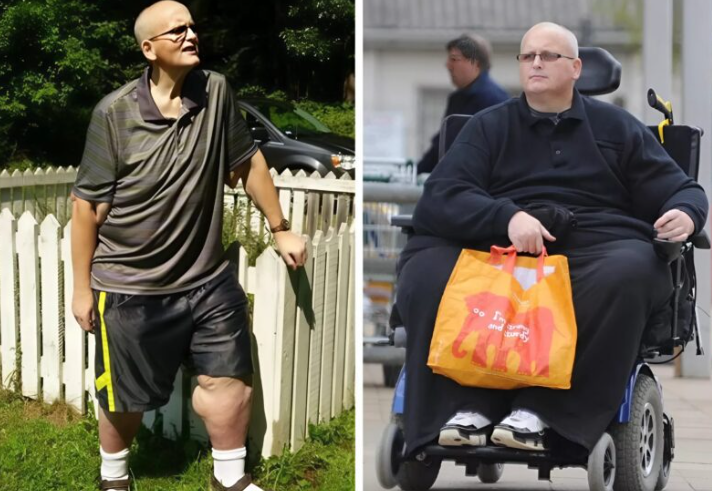
Six years ago, Paul Mason weighed 450 kg and was one of the heaviest people in the world. He was bedridden, isolated, and dependent on food deliveries, using video games to escape reality.
His story gained media attention and was featured in a documentary.
A woman named Rebecca saw the film, wrote to him, and they began corresponding. Their connection grew into love, and Paul decided to change his life.
After six years of strict dieting, surgeries, and relentless effort, he lost 305 kg. Now weighing 120 kg, Paul is unrecognizable.