I Served an Elderly Man Dinner for Two, but When No One Came, I Uncovered a Truth That Left Me Stunned

A Love That Never Faded

The elderly man at my café always ordered dinner for two. But no one ever came.

For months, I watched as he sat by the window, staring at the empty chair across from him, his fingers absently tracing the edge of his napkin. He never ate much, never lingered after finishing his tea.

One evening, as the rain tapped softly against the glass, I finally asked, “Sir, if you don’t mind me asking… who are you waiting for?”

He looked up, his weathered eyes filled with something between hope and sorrow. “Her name was Susan. And a year ago, she disappeared.”

A Love Story Left Unfinished

Tom’s voice was steady, but I could hear the ache beneath it.

“We met here, in this very café. I was always early, and she was always late. She’d rush in, flustered, laughing about some grand misadventure—a lost scarf, a runaway dog, an unexpected conversation with a stranger. She made life feel like a story waiting to unfold.”

He smiled faintly, but it quickly faded.

“A year ago, on my birthday, I asked her to meet me here. I was going to propose.”

He reached into his coat pocket, pulling out a small velvet box. His fingers brushed over it like a delicate memory.

“I sat here for hours, waiting. She never came. No calls, no messages. Just… gone.”

I gripped the edge of the table, my heart twisting. “And you never found out what happened?”

He shook his head. “I tried. I searched. But it was like she had vanished into thin air.”

Something in me refused to accept that ending.

“Do you have a picture?” I asked impulsively.

He hesitated before sliding a worn photograph from his wallet.

I studied her face—the warm eyes, the mischievous smile. There was life in that photo, a presence too strong to simply disappear.

“Come back Monday,” I said, handing the picture back. “I think I can help.”

A Desperate Search

I wasn’t a detective. I had no experience finding missing people. But I did know one thing—no one disappears without a trace.

I scoured old newspapers, searched through online records, and even checked local community boards. Nothing. No accidents, no missing person reports, no obituaries.

But then it hit me—hospitals.

If something had happened to her that night, if she had collapsed or been hurt, she would have been taken to the nearest emergency room.

I called in a favor from my friend Sarah, a nurse, who begrudgingly agreed to help.

“You owe me coffee for a year,” she muttered as we flipped through hospital records.

Minutes passed. My hope dwindled. And then—

“Here.”

I froze, staring at the file in front of me.

Susan had been admitted the night she disappeared. No ID. Severe head trauma. Memory loss.

No one had come to claim her. No missing person alert had been filed in her name.

But there was a contact number. I dialed it, my hands trembling.

A tired voice answered. “Hello?”

“I’m sorry for calling so late. My name is Emma. I’m looking for Susan Wilson. I think… I think she might be your mother.”

Silence.

Then, a deep, shaky sigh.

“She lost everything that night—her past, her name. But there’s one thing she’s never let go of. A place. A name.”

I closed my eyes. “Tom.”

“Yes.”

The Reunion

Tom arrived at the café on Monday, dressed in his best suit. His hands trembled slightly as he smoothed the tablecloth.

“She’s here,” I whispered, nodding toward the window.

A woman sat in a wheelchair outside, hands folded in her lap. Her hair was grayer than in the photo, her frame thinner.

Tom swallowed hard and stepped forward.

“Susan?”

Her eyes flickered to him. She studied his face, something stirring behind her gaze. A pause…

Then, a breathless whisper. “Tom?”

Tears welled in his eyes as he knelt beside her, his hands finding hers.

“It’s me, love. I’ve been waiting.”

Her lip trembled. “I thought I lost you.”

Tom cupped her cheek, his voice breaking. “You could never lose me.”

From his coat pocket, he pulled out the same velvet box he had carried for a year. He opened it, revealing the ring that had waited just as long as he had.

“Susan… will you marry me?”

Tears slipped down her cheeks. “Yes, Tom. A thousand times, yes.”

He exhaled shakily, pressing a kiss to her knuckles.

Behind them, her daughter covered her mouth, stunned. She had never seen her mother look this alive.

And for the first time in a year, Tom’s table was no longer set for two.

It was filled with love, laughter, and the promise that some stories aren’t meant to end unfinished.

3 Stories of People Who Became Homeless During Hard Times

It doesn’t take a lot to go from having a roof over your head to being out on the streets. All it might take is one bad choice or simply a cruel twist of fate.

1. Amber: I Had to Starve Myself for a Whole Week to Buy a Cellphone

My name’s Amber. Until recently, I was living what I thought was the dream life with my husband Louis and our son Allen. We seemed so happy. Then, suddenly, everything changed.

“We rushed into things, Amber. I can’t do this anymore!” Louis announced one evening. My heart just sank.

For illustration purposes only | Source: Pexels

For illustration purposes only | Source: Pexels

“Louis, you’re kidding, right? You can’t just leave us like that! What about Allen? He’s only two!” I pleaded.

“That’s the problem, Amber!” he retorted. “I’m tired of all the responsibilities. I need time for myself. I’ve found someone who gets what I’m going through!”

That night, as he walked out, I just fell apart. Once Louis was gone, reality hit me hard. I struggled to find a job while taking care of Allen alone.

Two weeks later, our landlady evicted us as I couldn’t pay the rent, and Social Services took Allen.

For illustration purposes only | Source: Pexels

For illustration purposes only | Source: Pexels

That night, I was homeless and heartbroken. My baby, my child, was taken away from me.

I sold everything I had, including my phone, and that kept me going for a while. Then, the money ran out.

One evening, out in the cold, I remembered my dad’s warnings about Louis. “He’s not right for you,” Dad had said. I wish I’d listened. Desperate to reconnect with him, I decided to buy a phone to call him.

I knew that if I borrowed a phone to call him, maybe he wouldn’t pick up the first time or even the second. But I’d have to keep trying….

I starved myself for a week to save enough to buy a second-hand phone. My tears didn’t stop when I dialed Dad’s number.

For illustration purposes only | Source: Pexels

For illustration purposes only | Source: Pexels

“Hello?” he asked.

“It’s… Amber, Dad,” I sobbed into the phone.

“Amber, sweetheart! Is that you? Oh God! How are things going?”

“I need your help, dad!”

“Is-Is everything okay?”

“Just come as soon as possible, Dad!” I said.

For illustration purposes only | Source: Pexels

For illustration purposes only | Source: Pexels

He arrived quickly. In a hotel room, I poured out my heart about the betrayal and my days on the streets. Dad comforted me.

The next day, Dad and I went to the orphanage to start the paperwork to bring Allen home. Once everything was finalized, Dad took Allen and me to New York.

He also hired a private detective to find out where Louis was. It turned out Louis had been cheating on me with his boss’s daughter.

When his boss found out the truth — that Louis was married and had abandoned his family — he fired him. Louis ended up living on the streets. It felt like justice was done.

Back home, with my dad and Allen, I felt stronger. Life had knocked me down but taught me resilience. And with Dad’s support, I knew we could face anything ahead.

For illustration purposes only | Source: Pexels

For illustration purposes only | Source: Pexels

Coming up next is Brandon’s story, a homeless man and father of 3 living in a tent. One day, he decided to help a stranger, ignoring his own needs, and his life was never the same again.

2. Brandon: I Gave My Last $2 to a Stranger at a Gas Station, the Next Day I Inherited His Company

Four months on the streets with my three kids taught me a lot about life’s harshness and the small acts of kindness that can keep hope alive.

For illustration purposes only | Source: Pexels

For illustration purposes only | Source: Pexels

We lived in a tent near a gas station, a makeshift home barely shielding us from the cold. It was tough, but we managed to find moments of joy, making the best of it.

One chilly morning, as I counted the few coins I had left, I decided to head into the gas station to buy a can of beans — our planned dinner for the evening.

Inside, I stumbled upon a scene that jolted my heart. An elderly man stood at the counter, confusion written all over his face.

“I’m sorry, young lady, what did you say about the water being funny?” he asked.

“I said you don’t have enough money, sir!” the cashier snapped.

For illustration purposes only | Source: Unsplash

For illustration purposes only | Source: Unsplash

“Yes, it is a sunny day!” he replied.

Suddenly, some young man in line grabbed the elderly man, yelling, “You need more cash!”

Watching this, my heart sank. The elderly man just wanted a bottle of water to take his pills, but his request for an affordable bottle was met with hostility. “If you can’t afford to pay, you’ll have to go!” the cashier shouted.

I couldn’t stand idly by. Stepping forward, I emptied my cup of change onto the counter. “Have a heart, lady,” I said, deciding to pay for the man’s water.

The cashier counted the money with distaste. “That’ll cover it,” she muttered. I left the can of beans and handed the water to the elderly man.

For illustration purposes only | Source: Pexels

For illustration purposes only | Source: Pexels

“Here you go, sir,” I spoke clearly, making sure he could read my lips.

“Why did you help me when you needed the money?” he asked me as we left the store, noticing my tent with kids nearby.

“If there’s one thing I’ve learned from being homeless, it’s that the world works when people are kind to each other,” I explained.

“But what are your kids going to eat?” he questioned.

“There’s a chance I’ll find some scraps at the fast food joint across the street,” I assured him.

For illustration purposes only | Source: Pexels

For illustration purposes only | Source: Pexels

The next morning, two jeeps parked near our tent, and a man in a fancy suit stepped out.

“Mr. Grives’ last wish was for me to deliver this to you,” he said. There was a letter offering me the inheritance of his business.

“Is it a joke?” I asked in shock.

The man handed me legal documents. With a mix of apprehension and hope, I signed the papers. This could be the break my children and I needed, a chance to escape the streets.

We were driven to a huge mansion. “Can we put up a tent under that tree with pink flowers?” my youngest, Derrick, asked innocently.

For illustration purposes only | Source: Pexels

For illustration purposes only | Source: Pexels

“We’re going to live inside that house, silly! Right, Dad?” my daughter Kelly chimed in.

As I nodded, the reality of our new life began to sink in. Yet, the moment I opened the doors, something was wrong. The house was in disarray — someone had been there.

“We’ve examined the entire perimeter of the house and found no sign of forced entry, sir,” the officer reported after I called 911.

That evening, I got an anonymous call. In a robotic yet menacing tone, the voice told me I had 24 hours to decline all that Mr. Grives’ left me, leave the house, or else I would lose everything I love.

For illustration purposes only | Source: Pexels

For illustration purposes only | Source: Pexels

The mansion came with Mr. Grives’ loyal staff, and one of them warned me that this could be the doing of Mr. Grives’ eldest son, Christopher. I resolved to go to the cops in the morning.

But in the morning, my kids were vanished! Although the clever perpetrator had managed to hide his face from most of the CCTVs in and around the house, there was one he didn’t know about.

Mr. Grives’ staff watched in horror as they recognized the leader of three thugs drugging my children. It was Christopher.

From there on, the cops put everyone on the task of tracking Christopher, and didn’t rest until later that afternoon, when Christopher were spotted on the border of the state with my kids in the back of an old van.

Christopher was arrested, and my children were safe. But their fear had set in deep, and I had a choice to make: to heal and embrace the gift that kind soul left us, or to walk away, rebuilding from the start.

“Daddy, are we going to leave our home again?” Kelly’s question broke my heart.

For illustration purposes only | Source: Pexels

For illustration purposes only | Source: Pexels

I wrapped my arms around them. “We’re going to be okay. You want to know why?”

“IBecause the most valuable thing we have is right here, in my arms. So long as we stick together, we’ll always be rich in the most important way: love.”

While Brandon was blessed with children who understand the value of kindness and love, Mr. Greg wasn’t. Coming up next is his story.

3. Mr. Greg: My Teen Daughter Humiliated the Homeless, I Had to Teach Her a Lesson

I always thought I was doing right things for my daughter, Jane. I made sure she had everything she needed, but I missed teaching her something crucial — compassion for others. This hit me hard a few days ago when I lost my wallet.

For illustration purposes only. | Source: YouTube/DramatizeMe

For illustration purposes only. | Source: YouTube/DramatizeMe

After a fruitless search, I returned home to find Jane mocking a homeless man and his daughter at our doorstep. The shock set in when the man handed me my wallet, untouched. I was moved by that man’s gesture.

But Jane dismissively called them “trash,” and spoke to them with so much disgust…it broke my heart. I knew I had to fix this.

That evening, I invited the man, Mark, and his daughter for dinner. It was my chance to teach Jane about generosity.

“Dad, check the money! He probably stole it!” Jane said as I checked my wallet. Everything was there.

“All the money is here, sweetie. You’re mistaken,” I told her.

Seeing Mark’s and Lolita’s discomfort, I invited them to stay for dinner.

For illustration purposes only. | Source: YouTube/DramatizeMe

For illustration purposes only. | Source: YouTube/DramatizeMe

“Why don’t you guys join us?” I said. “It’s the least I can do to thank you.”

During dinner, Jane gave them paper plates instead of proper dishes.

“Why not use the nice dishes I got you for your birthday?” I suggested.

As we ate, I encouraged Mark to share his story, but Jane kept interrupting with rude comments. Eventually, I lost my patience.

“Shut your mouth, Jane!” I snapped. “You don’t know nothing. Misfortune could strike anyone.”

For illustration purposes only. | Source: YouTube/DramatizeMe

For illustration purposes only. | Source: YouTube/DramatizeMe

I then revealed a painful truth to Jane. “It’s my fault. I worked too much, especially after your mother passed. We were the same once,” I confessed. “Do you remember our ‘camping trips’? We were actually homeless.”

Jane was stunned. “How did we get back on our feet?”

“A kind man gave me a job. That changed our lives,” I said with a sigh.

Then, I looked at Mark. “And now, it’s my turn to pay it forward,” I told him.

Mark nodded. “All I did was what a decent human should do,” he said.

For illustration purposes only. | Source: YouTube/DramatizeMe

For illustration purposes only. | Source: YouTube/DramatizeMe

“I had no idea, Dad. I’m sorry,” Jane said after a pause.

“It’s okay, honey. It’s not too late to learn from this,” I told her.

When it was time for Mark and Lolita to go, I suggested, “Why don’t you both stay the night? We have plenty of room, and it’s getting late.”

Mark hesitated, then gratefully accepted. “Thank you, Greg. This means a lot.”

But I knew I wasn’t done helping them. Offering them a night’s shelter would not alleviate their problems. So I made a decision.

For illustration purposes only. | Source: YouTube/DramatizeMe

For illustration purposes only. | Source: YouTube/DramatizeMe

A little kindness costs nothing, guys, and I was ready to make sure that little Lolita and her dad had a good life.

The next day, I offered Mark a job as a driver and arranged a temporary home for them. “And I’ll help you until you’re back on your feet,” I promised.

“Oh, Really?” Mark gasped. “Nobody is this kind nowadays! I won’t let you down, sir,” Mark told me in tears. “Thank you so much!”

The smile on Lolita’s face that day made me realize I’d done the right thing. As for Jane…my Janie changed. She became a better person, and I’m so glad for that.

For illustration purposes only. | Source: YouTube/DramatizeMe

For illustration purposes only. | Source: YouTube/DramatizeMe

If you enjoyed reading these, you might also enjoy these three heart-stopping stories where ‘dead’ people turned out to be alive, shocking their loved ones.

We’re curious: What do you think about these stories? Tell us in the comments!

I Overheard My Neighbor’s Daughter and My Husband Discussing Their Affair – Instead of Making a Scene, I Invited Her to Our House the Next Day

When Lexie hears her husband and their neighbor’s daughter talking about their affair, she doesn’t break down or lash out. Instead, she begins to plan. With a clever invitation and a shocking turn of events, she turns the tables on their betrayal, serving up karma with a side of style. Revenge has never tasted so sweet.

Mark and I had been married for a decade, with two kids, a mortgage, and what I thought was a stable life. Sure, Mark never helped out around the house — I was the one juggling work, the kids, cooking, cleaning, everything. But I convinced myself, “It’s okay. We’re a team.”

Except Mark was playing on a different team.

Last week, I came home from a long grocery run. My arms full of bags, I heard voices on the porch — Mark and Emma, our 25-year-old neighbor’s daughter. They were laughing, and my name came up. Something in my gut told me to hide and listen.

“I can’t believe she hasn’t figured it out yet,” Emma laughed.

Mark chuckled. “She’s so wrapped up with the kids and housework. She doesn’t even look like a woman anymore. You’re so much better, my princess.”

Then they kissed.


I stood there frozen, clutching the grocery bags, a storm of emotions swirling inside me—anger, humiliation—but somehow, I remained calm. I didn’t say a word to them. Instead, I quietly slipped in through the back door and started strategizing.

The next morning, I kissed Mark goodbye with a sweet smile and drove straight to Emma’s house. When she opened the door, I greeted her warmly. “Emma, I could really use your expertise. Would you be able to stop by tomorrow evening? I’m thinking about redecorating the living room, and I know you’ve studied design.”

She smiled, completely oblivious. “Of course! What time should I come over?”

I returned her smile, masking my true intentions. “Seven works perfectly.”

She had absolutely no idea what was coming her way.

The next evening, Emma arrived looking polished. I welcomed her graciously and invited her in.

As I guided her through the house, I stopped at different spots, explaining each one with purpose.

“Here’s the dishwasher. You’ll need to make sure it’s loaded and run every night—Mark never bothers with it, obviously. The kids’ laundry goes in this room, but please separate the colors and whites because their skin can react badly to certain detergents.”

She stared at me, wide-eyed, unsure of how to respond.

“Oh, and here’s the schedule for all their after-school activities,” I continued, handing her a color-coded chart. “Tuesdays and Thursdays are pick-up days, but Wednesdays are your free days to run errands. I’ve also written down the plumber, electrician, and pediatrician’s contact info, just in case you need it.”

Her confident smile began to crumble, replaced by a pale, uneasy expression.

“And this,” I said, leading her into the kitchen where the aroma of roast chicken filled the air, “is where you’ll handle all the cooking. Trust me, there’s a lot to keep up with—breakfasts, packed lunches for school and work, snacks, dinners, desserts. Mark prefers his steak medium-rare, by the way, but the kids? They’ll only eat it if it’s cooked so thoroughly it’s practically a rock.”

She gasped, her composure shattering completely.

“And don’t expect Mark to say thank you,” I added, my tone light but pointed. “Gratitude isn’t really his strong suit. The kids are picky eater, but I’m sure you’ll manage to figure it all out eventually.”

Just then, Mark walked in. The moment he saw us, his face went pale.

“Lex, what’s going on?” he asked, his voice tight and trembling.

“Oh, Mark!” I replied brightly. “I was just walking Emma through everything she’ll need to handle around the house. I thought it was time for me to start focusing on me. And maybe it’s time for me to find someone who treats me like the princess I am.”

Turning back to Emma, I added cheerfully, “Good luck with everything! You’re going to need it.”

Before either of them could say a word, there was a knock at the door.

When I opened it, Emma’s parents were standing there—Anne and Howard, the same kind couple who had often babysat my kids when I was in a pinch.

“Thank you for coming, Anne and Howard. And thank you for raising such a thoughtful daughter,” I began, smiling sweetly. “She and Mark have become so close that I figured it was time to officially welcome her into the family.”

“What are you talking about?” Anne asked, her expression shifting into confusion.

“I’m leaving,” I said lightly, “and Emma will be taking over from here. You must be so proud of her initiative!”

Anne turned to Emma, her voice laced with disbelief. “Emma, tell me this isn’t true. Tell me this isn’t what it seems.”

Emma’s face flushed as she stammered, “It’s not—It’s not what it looks like!”

Mark, unsurprisingly, tried to wriggle out of the situation.

“Lexie, this isn’t fair! Emma made the first move! She came onto me!” he protested, his voice rising in desperation.

“Oh, did she?” I said with a calm, raised brow. “So, you’re claiming you had absolutely no responsibility for sneaking around with a 25-year-old and disrespecting your wife in the process?”

Emma glared at me, her face twisted with anger, before storming out the door. Her parents hurried after her, mumbling apology after apology on their way out.

Mark turned back to me, panic written all over his face.

“Lexie, please,” he pleaded. “Can we just talk? We’ve been together for so long—you owe me that much, don’t you?”

I gave him a cold, bittersweet smile. “Oh, don’t worry, Mark,” I said. “We’ll talk—through my lawyer. He’ll call you tomorrow. But for now, I suggest you pack your things and leave.”

A week later, I heard from mutual friends that Emma had dumped Mark.

Two weeks after that, Mark came crawling back, begging for another chance. But I was so far beyond caring.

Months have passed since that fateful night, and I’ve never felt more alive. I’ve rediscovered parts of myself I thought were lost forever. I’ve taken up salsa dancing, and with it came a renewed sense of confidence, happiness, and freedom.

As for Mark? He’s still single. And, as I hear it, Emma’s parents aren’t exactly thrilled with her either. Funny enough, though, Anne now bakes pies and cakes for me regularly, and Howard swings by to rake the leaves in my yard.

Ah, karma. It has its way, doesn’t it?

Little Girl Stopped Me on the Street and Said, ‘Your Picture Is in My Mom’s Wallet!’ – When I Saw Her Mom, I Was Speechless

I had forgotten what it was like to breathe without checking my phone every few seconds. My sister had nearly pushed me on the plane, claiming that I needed a break from running my software company.

I’d been in this small coastal town for three days, and while its appeal was evident (weathered boardwalks and salt-sprayed businesses), I felt out of place.

That morning, I decided to expend some of my restless energy by running through the peaceful streets.
“Mister, wait! Mister! I know you!”

A little girl, maybe eight years old, was sprinting toward me, her wild locks bouncing with each step.

“Mister, come with me! To my mom! Come on!”

I softly but firmly drew my hand away, alarms ringing in my thoughts. “Wait, little one. What’s your name? And how do you know me?”

“My name’s Miranda! Your picture is in my mom’s wallet! I see it all the time!”

For illustrative purposes only.
“Miranda, that’s… that’s impossible. I don’t know anyone here.”

“Yes, you do! You know my mom!”

“Who’s your mom? And why would she have my picture?”

“Julia! My mom’s name is Julia!” She bounced on her toes, almost quivering with excitement. “She looks at your picture sometimes when she thinks I’m not watching. She gets all quiet after.”

“I’ll walk with you, but no hand-holding, okay? I don’t want anyone thinking I’m up to no good.”

She nodded, accepting the compromise, and moved ahead of me, checking back every few paces to verify I was following.

We arrived at a modest house with white shutters and a garden full of vibrant flowers.

For illustrative purposes only.
“Mom! Mom! He’s here! He’s here! The man from your wallet! He’s here!”

Miranda reappeared, virtually pulling a woman with her.

When the woman spotted me, she froze. Her palm rushed to her mouth, and tears welled her eyes.

I didn’t recognize her at first, until she lowered her hand, bringing eight years of buried memories rushing back.

“Meredith? Is that you?”

“You left, remember?” Julia’s remarks came out harsh and nasty. “That day at the café. You told me you didn’t want to be with someone who only cared about your money.”

For illustrative purposes only.
My sister had shown me paperwork — fake documents, I later understood — indicating Julia had a history of seeking affluent men and had debts she was attempting to repay.

I had blindly believed everything, too preoccupied with my worries of being exploited to see what was right in front of me.

“You acc:us:ed me of chasing after rich men and told me your sister showed you documents detailing my debts. I never had any debts.”

“I knew that if I told you about the baby, it would only confirm your sister’s lies about me. And I couldn’t do that because I truly loved you. And… I have my pride.”

Miranda stood between us, her small hand gripping her mother’s, appearing perplexed by the tension she had created. My daughter!
“Why ‘Julia’?” I managed to ask, trying to make sense of anything in this moment. “Why did you go by Meredith back then?”

For illustrative purposes only.
“Meredith was my middle name. I used it that year because I’d just lost my grandmother. She was also called Meredith. I thought you knew that. But I guess there were a lot of things you didn’t know about me. You were always so busy…”

“I was wrong,” I said, my voice cracking. “About everything. I believed lies, and I let them ruin us. But now… now I want to make it right.”

“But I can be here from this moment forward if you’ll let me. For Miranda. For both of you.”

Julia’s shoulders slumped slightly. “We can try,” she said finally. “But slowly. And at the first sign that you’re going to disappear again…”

Miranda lunged at me, wrapping her arms around my waist. After a few hesitations, I hugged her back.

My sister was correct about one thing: I needed a vacation from my daily existence. But instead of finding rest, I discovered something I hadn’t realized I was missing: an opportunity to reclaim the family I’d nearly lost forever.

An old couple had been married for 50 years.

An old couple had been married for 50 years.

Every morning (without fail) the man produced a massive fart when he got out of bed and then laughed like a madman.

Also every morning, his wife would admonish him: “One of these days you’re going to fart your guts out.”

It’s Thanksgiving morning.

The old man is sleeping in and the old lady is in the initial steps of preparing the turkey. While she has a handful of turkey innards, she gets an idea.

She tiptoes up the stairs and into the bedroom. She carefully pulls back the waistband of her husband’s jockey shorts and loads him up with warm turkey guts.

An hour later the woman hears him stirring.

She hears his feet hit the floor and then the normal fart-laugh sequence.

The laugh stops abruptly and is followed by a scream, and then 10 minutes of utter silence.

The man eventually comes down the stairs and says to his wife: “Honey, I owe you an apology. For years, you’ve been telling me that I was going to fart my guts out. Today it finally happened, but by the grace of God and these 2 fingers (raises soiled 1st and 2nd digit) I got ’em all back in and I’m gonna be OK.”


An old married couple went camping.

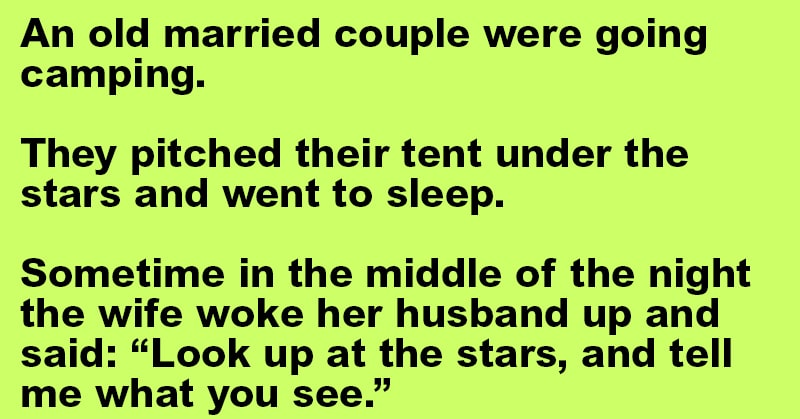
An old married couple were going camping.

They pitched their tent under the stars and fell asleep.

In the middle of the night, the wife woke her husband and said, “Look at the stars and tell me what you see.”

The husband replied, “I see millions and millions of stars.”

The wife said, “And what do you make of that?”

The husband replied, “Well if there are millions of stars and even some of them have planets, it’s quite likely there are some planets like Earth out there. And if there are a few planets like Earth out there, there might also be life.”

There was a slight pause before the wife said: “No honey, it means that somebody stole our tent.”

LOL!! 

Dr. Phil: Overcoming Adversity and Achieving Success

Dr. Phil is a name that is recognized worldwide, known for his fame, wealth, and undeniable success. But what many people may not know is that his journey to the top was far from easy.

In fact, Dr. Phil had to overcome numerous obstacles and face adversity throughout his life. His story is one that resonates with many, showing that with resilience and determination, anything is possible.

A Challenging Childhood

Growing up in an abusive household, Dr. Phil’s early years were marked by turmoil and instability. His father’s alcoholism led to constant moving, with the family changing residences every few years. Dr. Phil often tried to avoid his father, who displayed unpredictable mood swings and engaged in disturbing behavior due to his drinking.

Dr. Phil candidly shared the chaos he experienced during those times, stating, “[I] came and went through the bedroom window so I didn’t have to go through the house. It was total chaos…Yelling, screaming, domestic violence.” It was a challenging environment that shaped his character and tested his resilience.

From Homelessness to Success

As if his troubled childhood wasn’t enough, Dr. Phil also faced extreme poverty during his teenage years. In 2021, he revealed that he had been homeless and slept in a cardboard box on the streets of Kansas City. These experiences gave him a unique perspective on life and further fueled his determination to create a better future for himself.

The Turning Point

In 1996, Dr. Phil’s life took a remarkable turn when he crossed paths with Oprah Winfrey. At the time, Winfrey was facing a defamation lawsuit and enlisted Dr. Phil to provide counsel and support during the trial. This encounter led to a strong partnership, and Dr. Phil soon became a regular guest on The Oprah Winfrey Show.

Four years later, Dr. Phil launched his own show, which skyrocketed his popularity even further. With 24 Emmy nominations and a devoted audience, he became a household name across the globe. His journey from homelessness to international fame is a testament to his resilience and the power of hard work.

Love and Support

Throughout his challenging journey, Dr. Phil found love and support in his marriage to Robin McGraw. They shared a deep connection from the very beginning, with Robin describing how she knew he was “The One” after their first evening together. They had open and honest conversations about their needs, with Robin expressing her desire for a relationship built on love, adoration, dignity, and respect.

Inspiring Others

Dr. Phil’s story serves as an inspiration to people from all walks of life. It shows that no matter the obstacles one faces, with determination and perseverance, it is possible to overcome adversity and achieve success. Dr. Phil’s life is a testament to the fact that hard work and resilience can take you anywhere.

So, if you’re a fan of Dr. Phil or have ever watched his famous show, we’d love to hear from you. Let us know in the comments below and share this article with others on Facebook. Dr. Phil’s story is one that should be shared and celebrated, as it reminds us all that we have the power to overcome any challenge and create a better future.

Promise me you won’t get married again

A newly married couple is in bed when the man asks his wife how many men she has slept with After the question, the woman doesn’t respond.

The man asks again “Just tell me, it’s fine. How many men have you slept with?”

His wife, still in total silence, just stares at the ceiling.

The man says “I am sorry. I didn’t mean to upset you. I just thought we could trust each other…”

Still silence from his wife.

The man, giving up, says “It’s OK. Please don’t be upset.”

Since the woman is still silent, the man starts hugging and kissing her, showing his affection.

While he is doing this, his wife seems to come to her senses, stops looking at the ceiling, looks at him, and upset, tells her husband,

“Damn it! You made me lose count!”

ANOTHER JOKE

If I die promise me you won’t get married again

Oh so sweet. You want to be my only one

…No, it’s not that.

I just don’t want two people mourning me at the same time!

Trump Agrees to Pause Tariffs on Canada and Mexico, But China Not Spared

President Trump has decided to temporarily halt the implementation of 25% tariffs on goods from Canada and Mexico for a 30-day period. This decision averts a potential trade conflict with these vital North American allies.

In conversations with Trump, Canadian Prime Minister Justin Trudeau promised to bolster Canada’s border security with the U.S.

This move aims to curb illegal migration and the trafficking of fentanyl, a potent drug that has been a significant concern for the U.S. administration.

Similarly, Trump reached an agreement with Mexican President Claudia Sheinbaum, who committed to strengthening Mexico’s northern border with military personnel.

In return, the U.S. would control the export of firearms into Mexico.

However, the scenario is starkly different with China, as a 10% tariff on Chinese imports is now in effect following a midnight deadline. This has triggered a wave of retaliatory tariffs from Beijing on various American products, including coal, liquefied natural gas, crude oil, and agricultural machinery, with rates ranging from 10% to 15%.

Trump expressed his intention to communicate with the Chinese leadership soon, referring to the new tariffs as a preliminary step that could escalate significantly if no resolution is achieved.

Canada and Mexico responded promptly to the initial tariff threats by preparing their own countermeasures. However, recent phone discussions led to the announcement of a temporary accord, effectively delaying tariff enforcement for 30 days. Trump and Trudeau both celebrated the outcome as a diplomatic victory.

“As president, it is my responsibility to ensure the safety of ALL Americans, and I am very pleased with this initial outcome,” Trump shared on Truth Social.

Prime Minister Trudeau revealed that Canada is rolling out a comprehensive $1.3 billion border security plan. This initiative includes deploying nearly 10,000 frontline workers and improving resources to combat fentanyl trafficking. Additionally, Canada plans to establish a dedicated role for a “fentanyl czar” and a joint task force with the U.S. targeting crime, fentanyl distribution, and money laundering.

The Canadian border strategy was initially set in motion last December, featuring increased coordination with U.S. law enforcement, enhanced information exchange, traffic management measures at border crossings, and the use of drones and Black Hawk helicopters for surveillance purposes.

Shortly before the deal with Canada, Trump had deferred tariffs on Mexican products in exchange for Mexico committing 10,000 National Guard troops to its border. President Sheinbaum broke this news on X, recounting a “good discussion with mutual respect for our sovereignty” with President Trump.

Back in 2019, the Mexican government had also consented to dispatch 15,000 troops to its northern boundary to evade U.S. tariffs imposed by Trump’s administration. Both leaders described their phone exchanges as amicable.

President Trump regards tariffs as a strategic tool for economic growth, job protection, and raising tax revenues, asserting, “Tariffs, for us, create an advantage because nobody can compete with the U.S. as we sit as the proverbial pot of gold.” Nevertheless, he acknowledged that continued prosperity is vital to maintaining this position.

Economists have cautioned that retaliatory tariffs could lead to increased prices across numerous product categories including automobiles, timber, steel, food, and alcoholic beverages. Prior to the announcement of the tariff suspension, some products had already been pulled from shelves, and stock markets witnessed a downturn on Monday, though they later stabilized with the news.

Andrew Furey, Newfoundland and Labrador’s premier, acknowledged the 30-day respite offers some relief. Still, he advised Canadians to stay vigilant as the threat of a trade war persists. Furey expressed hope for a “calm Canadian diplomatic approach” in future tariff discussions while cautioning against further erratic measures from the U.S. administration.

Ontario’s Premier, Doug Ford, echoed relief and gratitude for the temporary reprieve from duties, opting to suspend planned responses. However, Ford remained observant, noting, “Canada and Ontario remain poised in the face of the potential for tariffs—regardless of whether they arise tomorrow, in a month, or in a year. President Trump may continue to leverage tariffs as a negotiation tool.”

Trump has suggested that the European Union could soon find itself targeted by U.S. tariffs, though details are sparse. In a more favorable light, Trump indicated that the United Kingdom might be exempted from significant trade duties, especially after its departure from the EU in 2020.

Our Joke of the Day

A lawyer married a woman who had previously divorced five husbands. On their wedding night, she told her new husband, “Please be gentle, I’m still a virgin.” “What?” said the puzzled groom. “How can that be if you’ve been married five times?”

“Well, Husband 1 was a sales representative; he kept telling me how great it was going to be.

Husband 2 was an engineer; he understood the basic process but wanted three years to research, implement, and design a new state-of-the-art method.
Husband 3 was in marketing; although he had a nice product, he was never sure how to position it.
Husband 4 was a psychologist; all he ever did was talk about it.

Husband 5 was a stamp collector; all he ever did was… God! I miss him!

But now that I’ve married you, I’m really excited!” “Good,” said the lawyer, “but why?” “You’re a lawyer!” she replies. “This time I know I’m going to get screwed.”

I asked my neighbor to clean up after using my BBQ, and the next day she posted rules on my door, demanding I follow them.

Six months ago, everything in my quiet cul-de-sac changed when my new neighbor, Elena, moved into the house next door. At first, she seemed perfectly ordinary—a friendly woman in her early 40s living with her teenage son, Julian. I assumed she’d keep to herself and mind her own business. After all, our neighborhood had always prided itself on civility and respect.

I’m Veronica, a suburban mom juggling work, kids, and an overstuffed schedule. My husband, Travis, and I had always tried to be the model neighbors—helpful, kind, and generous. So when Elena asked to borrow a ladder to fix her gutter, I readily lent it without hesitation. Over time, I even offered her our garden hose and, one sunny afternoon, invited her to use our outdoor grill station while we were away.

At first, everything went smoothly. Elena was courteous, always greeting us with a smile. I even thought she’d become a friend—a neighbor who respected our shared space and understood the unspoken rules of suburban living. I never imagined that what seemed like simple neighborly kindness would later morph into a full-blown fiasco.

One weekend, Travis and I planned a short getaway to visit my parents, hoping for a brief escape from our busy lives. “It’ll be a date night,” Travis promised as he packed snacks for the drive. I looked forward to it—a chance to relax, if only for a couple of days. We left our home with our kids in the safe hands of family, confident that our well‑maintained yard would be just as we left it.

But when we returned, the sight that greeted me was beyond belief. Our backyard, once a neat, orderly oasis, was in utter disarray. Empty beer bottles littered the patio, our beloved potted plants had been upturned and scattered, and the deck was marred by greasy stains. Toys were strewn about, and the grill station—our pride and joy—looked as if it had barely survived an explosion.

My heart pounded as I stood at the doorway, disbelief and fury warring within me. I could only think, “What on earth happened here?” After taking several deep, steadying breaths, I realized that if there was an explanation, I needed answers. Determined not to let this disrespect go unanswered, I grabbed my keys and headed next door.

I knocked on Elena’s door. Moments later, she answered in her cozy pajamas, her hair slightly tousled, and an air of nonchalance about her. “Oh, hey, Veronica,” she said with a light laugh. “That mess? That was Julian’s birthday party. You know how teenagers are—always causing a ruckus.”

I stared at her, stunned. “A birthday party? Elena, our backyard isn’t a community playground. You—or rather, your son—turned it into a disaster zone! There are empty bottles, overturned plants, grease everywhere… and you just brush it off?”

She shrugged, an amused smile playing on her lips. “It’s just a little mess, Veronica. I’m sure you can easily hose it down. Besides, I’m sure you and Travis have a hose, don’t you?”

I could hardly believe her dismissive tone. “Elena, respect is the least I expect as a neighbor. I let you use our grill and our equipment, and I assumed you’d return things in the condition you borrowed them. This isn’t acceptable.”

Her tone turned light but unwavering. “Oh, come on. It’s nothing—kids will be kids. Clean it up, Veronica. I’m sure it’ll wash away with a bit of water.”

My eyes narrowed. I felt my temper flare. “My backyard isn’t your personal junkyard, Elena. I expect some basic respect for my property.”

Before I could press further, my daughter Sierra dashed out of the house, phone in hand. “Mom, you need to see this!” she cried. I followed her to the living room where she showed me a video on social media.

In the video, Julian and a group of his friends were seen laughing, tossing beer bottles around, and treating our backyard as if it were their private hangout. They boasted about using my space for their party and even mimicked a carefree attitude that bordered on defiance.

I felt a rush of indignation. Without a second thought, I grabbed my phone and recorded a detailed video of our trashed yard—from the scattered bottles and ruined plants to the greasy, battered grill station. I made sure to zoom in on every disrespectful detail. Then I posted it on my social channels with a caption that read, “So glad my neighbor and her son enjoy my backyard more than I do!”

Within hours, the post went viral. Comments poured in—shock, laughter, outrage, and disbelief. People couldn’t believe that someone would treat another’s property with such blatant disrespect. One comment read, “Your yard isn’t a frat house, lady!” Another said, “Time to put up a fence ASAP!”

By the end of the day, the video had amassed millions of views and a flurry of shares. Among the flood of responses, a man offered his services—he specialized in installing chain‑link fences. By week’s end, my backyard was fortified, a secure barrier ensuring that no one could trespass or misuse my property without my permission.

I sat on my porch that evening, a mix of satisfaction and sorrow swelling within me. I had stood up for myself, but at what cost? I wondered what Elena would do now that I had taken such a bold stand. And deep down, I couldn’t shake the feeling that this was only the beginning of a conflict that would have consequences far beyond my front yard.

The Neighbor’s Retort
The very next morning, I found a note taped to my front door—a note that was not mine. With trembling fingers, I unfolded it and began to read:

“Dear Neighbors, To keep things harmonious, I’ve established a few basic rules:

No grilling past 7 PM—my sensitive nose can’t handle the fumes.
No spicy seasonings near my property—my son finds the aroma distracting.
When I’m using the grill, please stay off my yard.
Always notify me before using the grill—scheduling is key.
The garden hose is for community use only—for watering my prized roses and washing my car.
Patio furniture is communal.
Mow your side, and while you’re at it, mow mine too.
Be patient if my son leaves a mess—kids will be kids!
I may need extra parking space occasionally—my driveway is sometimes available.
And if you have any concerns, feel free to discuss them with me, but remember—I know best for our community. Sincerely, Elena”
I read it over and over, my mouth dropping open in disbelief. Elena had not only invaded my backyard with her rowdy party but now had the nerve to impose her own “community rules” on my property! I nearly choked on my morning coffee. This was not a joke—this was her official decree.

Before I could fully process the note, my eldest, Sierra, burst into the kitchen, phone in hand, her eyes wide. “Mom, you have to see this!” she exclaimed, showing me a TikTok video of Julian and his friends laughing and goofing around in our yard, making fun of the mess they’d left behind. In the video, they even mimicked reading Elena’s rules with exaggerated mockery.

I felt my blood boil. This wasn’t just about a trashed backyard anymore—it was about respect. I grabbed my phone, marched out to my backyard, and recorded every detail: the overturned potted plants, the scattered beer bottles, the greasy grill, and the absurd list of rules taped to my door. I posted the video online with the caption, “Glad my neighbor and her kid enjoy my backyard more than I do! #NeighborhoodFail.”

Within a few days, the video exploded online. Views soared into the millions, and comments poured in. People were outraged by Elena’s audacity. Some wrote, “Your yard is YOUR yard—put up a fence!” Others exclaimed, “Who does she think she is?” The backlash was swift and merciless.

A contractor even reached out through the comments, offering to build a secure, chain‑link fence around my property. By the end of the week, a fence was erected, and my backyard was suddenly off‑limits—not just for Elena, but for anyone without my permission. It was a line in the sand.

But the fallout didn’t stop there.

Two days later, a knock on my door interrupted a quiet afternoon. I opened it to find Julian standing on my doorstep, his eyes downcast and voice trembling. “Ma’am, please,” he mumbled, “you’re ruining my life.” He explained that after the video went viral, his schoolmates had found out that he was the one behind the party. The teasing, the whispers, and the endless jokes about his “wild” behavior had made his life a living hell.

I was taken aback. I hadn’t meant for any of this to happen—my protest had been aimed at protecting my property, not to shame a teenager. “I’m sorry, Julian,” I said softly, “but you need to understand that you should have cleaned up after yourself. I never said I didn’t mind you using the grill or having your friends over. I just expected respect for my property.”

He nodded miserably. “I know. I… I didn’t think it through.” He looked up, eyes pleading. “I’ll delete the videos if you do.” After a long pause, I sighed, “Alright. I’ll delete them, but you have to promise to clean up next time. And please—don’t let this happen again.”

He mumbled his agreement and shuffled away, leaving me to wonder how a single incident could spiral so far out of control.

Online Outcry and a Line Drawn
That evening, I sat on my back porch and scrolled through the comments on my viral video. The outpouring of support was overwhelming. Strangers from across the country praised my stance, while many condemned Elena’s audacity. One comment read, “No one should treat their neighbor’s property like their personal playground!” Another said, “Your neighbor’s got serious issues if she thinks she can dictate your space!”

It wasn’t long before local news picked up the story. Soon, my video was featured on community blogs and even local TV segments. I received messages from neighbors who said, “I had no idea this was happening. I’m so glad someone stood up for themselves.” The internet had turned my personal battle into a public call for respect, and it seemed that Elena’s overreach was now a matter of neighborhood pride.

By midweek, a local contractor who specialized in chain‑link fences contacted me directly. He explained that many residents in our area were facing similar issues with over‑bearing neighbors and that he’d be happy to install a secure fence to protect my property. After a brief consultation, I gave him the go‑ahead, and within days, my backyard was enclosed by a sturdy fence that left no room for unwelcome intrusions.

The next morning, as I sipped my coffee and admired the new barrier, I received an unexpected visit. Elena, looking less put‑together than before—her hair messy, her posture slumped—stormed up to my door holding a wooden spoon. “You’re breaking my rules!” she shrieked, pounding on my door. I opened it cautiously, meeting her furious gaze.

“Your rules?” I asked coolly. “I don’t recall agreeing that my property was yours to dictate.”

She huffed indignantly. “I said that you must abide by the rules I posted for the sake of our community!”

I forced a smile that didn’t reach my eyes. “I’m sorry, Elena, but if you want me to respect your ‘community rules,’ you might want to look at your own backyard first.” My tone was even, but the words were edged with all the pent‑up frustration of the past few days.

Elena sputtered and tried to retort, but before she could, I stepped back, closing the door firmly. I could already sense that the drama was far from over.

Later that afternoon, while checking my messages, I saw a series of furious texts from Elena demanding that I remove the fence and “follow her rules.” I typed back a calm reply: “My property, my rules. I have every right to protect my space. I’m sorry if that offends you.” No response came immediately, but I knew this was only the beginning of a feud that would ripple through our little neighborhood.

That night, as the streetlights flickered outside and a cool breeze whispered through the trees, I wondered what would happen next. Had I overstepped, or was this simply a necessary stand for respect? One thing was clear: Elena’s entitlement had sparked a conflict that would force everyone to learn some hard lessons about boundaries, respect, and the cost of neglecting one’s own property.

Setting Boundaries
The next morning, I resolved that I wasn’t going to back down. I had spent too long feeling invisible and taken for granted. With a determined sigh, I drafted a simple list of my own “house rules” for respectful behavior toward my property:

Use of my grill and outdoor amenities requires prior permission.
All borrowed items must be returned in the condition they were given.
Cleanup is mandatory after any gathering.
Respect for personal property is non‑negotiable.
Armed with this list, I printed out a few copies and taped one to my front door alongside the chain‑link fence. I left a copy in the mailbox for Elena as well, hoping that a clear statement might settle the matter.

That afternoon, while I was tending to my garden, my phone buzzed with yet another message from Elena. This time, it was a long diatribe, accusing me of being unreasonable and selfish. “You think you can dictate what I do in our neighborhood? You’re not the boss of me!” the message read in all caps. I took a deep breath before replying: “I simply expect basic respect for my own property. If you disagree, perhaps we can discuss it face‑to‑face like adults.”

No reply came immediately. I spent the rest of the day with a mixture of apprehension and relief. For the first time in weeks, I felt as though I was standing up for myself. Yet a small voice in the back of my mind warned me that this battle might have repercussions I hadn’t anticipated.

That evening, during dinner with Travis and the kids, I noticed a subtle shift in the household atmosphere. Travis, who had been mostly silent since the incident, finally spoke up. “Veronica,” he said softly—using my full name as if to emphasize sincerity—“I’m sorry for letting things slide with Elena. I know you’ve been carrying all this on your own, and I promise to do more.”

I managed a small smile. “Thank you, Travis. I just needed someone to understand that my home is my sanctuary, and I deserve to feel respected in it.”

The kids, sensing the tension, remained quiet at the table. Later, after they were in bed, Travis and I sat in our living room discussing ways to ensure that our home remained a safe space. We talked about the importance of boundaries, how to handle conflicts with neighbors, and even brainstormed creative ways to discourage further transgressions. I suggested that we could install security cameras or even host a neighborhood meeting, but Travis cautioned me to be careful not to escalate things too far.

For now, it seemed the simple act of posting my rules and erecting a fence had made a statement. But I knew deep down that Elena’s pride wouldn’t let her take this lying down. The coming days would reveal whether she’d choose to adapt or escalate the conflict.

That night, as I reviewed my journal entries before bed, I reflected on the past few weeks. I had learned that sometimes, setting boundaries was the only way to reclaim one’s dignity. Even if it meant drawing a line in the sand and risking a feud with an entitled neighbor, I knew I had to stand my ground. My home was mine, and I wouldn’t let anyone—no matter how charming or friendly they initially appeared—disrespect it.

The Digital Spotlight
Over the following week, the tension between Elena and me simmered just beneath the surface. I tried to maintain a semblance of normalcy in my daily life—feeding the kids, tending to the garden, and even inviting Travis to join me for a quiet cup of coffee on our front porch. Yet every time I glanced at the fence or the rules taped to my door, memories of the chaotic party and the invasive note flooded back.

One afternoon, while browsing through my social media feed, I noticed that my earlier video of the trashed backyard had exploded in popularity. Comments ranged from outrage at Elena’s entitlement to humorous jabs at her “new neighborhood rules.” One comment read, “Your yard is your kingdom—defend it!” Another said, “When neighbors start dictating rules for YOUR property, you know it’s time to put up a fence.”

It was then that I realized the power of the online spotlight. What had started as a personal grievance had become a viral sensation. Encouraged by the overwhelming support and the shared outrage of thousands, I decided to take my protest one step further. I recorded a detailed video outlining the entire ordeal—from the initial lend of the grill and garden hose, through the disastrous party, to Elena’s ridiculous list of rules—and posted it on all my social channels with the caption: “When your neighbor thinks your backyard is her personal playground, sometimes you have to expose the truth.”

The response was immediate and explosive. Within 48 hours, the video had garnered millions of views and sparked heated debate across the internet. People from all over chimed in with their own stories of entitled neighbors and property disputes. Local news outlets even reached out for interviews, and soon, my story was making headlines. “Backyard Battle Goes Viral!” read one headline. “When Neighbors Wage War Over a Grill” read another.

Elena’s reaction, however, was swift and furious. Late one evening, I received an email from her attorney—a sternly worded notice demanding that I take down the video and retract my statements, or face legal action for defamation. My heart pounded as I read the email. I had expected backlash, but the idea of a legal battle over something as personal as neighborhood respect filled me with both anger and resolve.

I called Travis immediately. “We need to figure this out,” I said, my voice shaking. “Elena’s attorney wants me to take down the video, but I can’t. People have a right to know how she treats our property!”

Travis tried to calm me down. “Veronica, I understand, but maybe we should consider a compromise. This is spiraling out of control.”

But I couldn’t back down. “No, Travis. I’m not going to be silenced. I stood up for my home, and I’m not about to let someone bully me into submission.”

That night, I drafted a statement to post along with the video, clarifying that my intent was not to slander Elena but to highlight a matter of personal respect and property rights. The statement read: “I believe in neighborly courtesy and mutual respect. When someone crosses the line and uses my property as if it were their own, I have every right to defend my space. I stand by my story.”

The fallout was intense. The online community rallied behind me, and even local politicians began discussing the need for clearer neighborhood guidelines and stronger protections for homeowners. Elena’s social media accounts were bombarded with negative comments, and it wasn’t long before I saw a dramatic drop in her online following.

In the midst of the digital uproar, I couldn’t help but feel a mix of vindication and sorrow. Vindication, because I had finally forced someone to acknowledge that my home—and my rights as a homeowner—were not up for grabs. Sorrow, because I never wanted our neighborhood to descend into a public war, and because I knew that some conflicts leave scars that go deeper than any fence ever could.

That night, as I lay awake listening to the hum of the neighborhood lights, I wondered what Elena would do next. Would she back down? Would she escalate further? And most importantly, what would this mean for our once‑peaceful community?

Ripples Through the Neighborhood
In the days that followed the online uproar, the atmosphere in our neighborhood shifted dramatically. Conversations in the cul‑de‑sac now revolved around property rights, neighborly respect, and the ethics of social media shaming. I received supportive messages from neighbors I had never even met, and local community leaders expressed interest in hosting a town meeting to address similar issues.

At home, the tension between Elena and me had not vanished, but it had taken on a new form. Elena began to appear less confident in her previously domineering manner. I noticed her car parked further down the street instead of right next to mine, and she no longer casually borrowed our tools. Instead, she avoided eye contact and seemed to keep her distance.

One sunny afternoon, as I was tending to my newly fenced yard, I spotted a small group of neighbors gathered near the entrance. Curious, I approached and discovered that they were discussing the recent events. “I never thought someone would go viral over a backyard,” one man remarked. “But you really stood your ground, Veronica,” said a woman with a sympathetic smile.

It was in these casual conversations that I began to see the broader impact of my actions. My video had not only exposed one entitled neighbor’s behavior—it had sparked a community dialogue about the importance of respecting personal space and the rights of homeowners. Local news reports mentioned that several residents had come forward with similar stories of neighbors who overstepped boundaries.

Travis, who had been quiet since the incident, joined me on one of these walks. “I’m proud of you, V,” he said, using the nickname he’d given me years ago. “I know it wasn’t easy, but you forced us all to wake up and stand up for what’s right.”

I squeezed his hand in gratitude, even though a small part of me still mourned the loss of the peaceful neighborhood we once had. “I never wanted to create a public feud,” I admitted. “I just wanted basic respect for my own home.”

Over the next few days, I received a surprising message from Elena. It was a short note taped to my mailbox. In neat handwriting, it read: “I’m sorry for the chaos. Let’s talk.” My heart raced as I considered what this might mean. Was she finally ready to acknowledge that she’d overstepped? Or was this just another tactic to regain control?

I decided to meet her halfway. That evening, I stepped next door, unsure of what to expect. Elena greeted me at her door—this time in casual clothes, her demeanor subdued. “Veronica, I realize I may have been too overbearing,” she began, looking down at her hands. “I never intended for things to spiral this far. I’m sorry if I made you feel disrespected.”

I took a deep breath. “Elena, I’m not out to ruin anyone’s life. I just want my home respected. I lent you my things out of neighborly kindness. I expected that kindness to be reciprocated with basic decency.”

She nodded slowly. “I understand. I admit, I set some rules that I now see were unreasonable, and I let my son get out of control. I truly regret that our interaction has caused such a public spectacle.”

We talked for a while—about boundaries, about how we could coexist without infringing on each other’s rights, and even about the pressures of single‑parent households. I wasn’t ready to forgive everything, but I appreciated her willingness to talk. I told her, “I want to believe we can move forward, but respect is non‑negotiable.”

By the end of our conversation, we agreed to try and keep things civil and to discuss any issues directly rather than resorting to public platforms. It wasn’t a complete resolution, but it was a start. I returned home with mixed feelings: relief that the conflict might de‑escalate, but also apprehension about the long road ahead.

That night, as I logged off social media and prepared for bed, I reflected on the strange twists of fate that had turned a simple neighborhood dispute into a communitywide debate. I realized that sometimes, lessons are learned the hard way, and that respect for one’s property and personal space is something we must all defend—even if it means taking our battle online.

The Fallout Deepens
In the weeks following our conversation, things in the neighborhood continued to shift. While Elena and I had tentatively agreed to communicate directly, the online storm we’d ignited still raged on. I received emails and messages from people sharing their own experiences with entitled neighbors, and local community forums buzzed with discussions about our “Backyard Showdown.” Even the local council had received several complaints and inquiries regarding property rights in our cul‑de‑sac.

At home, I noticed that Travis and I were more mindful of our boundaries. We began discussing ways to safeguard our property further, and I even installed a few extra security cameras near the fence. Every evening, as I reviewed the footage, I was reminded of the invasion of privacy I’d endured—and of the importance of standing up for myself.

One particularly tense afternoon, as I was raking leaves in my backyard, I saw Elena across the street watching me from behind her window. Her gaze was hard to read—was it regret? Anger? Or simple resignation? I called out, “Elena! If you have something to say, just come over and talk like we agreed.” For a long moment, there was only silence. Then, slowly, she lowered her gaze and turned away. I sighed, knowing that some wounds take time to heal.

Meanwhile, my social media post continued to draw attention. A local influencer even interviewed me on a live stream, asking about the challenges of modern neighborly relations. “What would you do if someone disrespected your property?” they asked. I responded honestly, “I’d stand up for my rights, and if necessary, expose the truth so that we can all learn that respect isn’t optional.” The interview sparked even more conversation, and soon the hashtag #BackyardRespect began trending locally.

Despite the public support, I couldn’t help but feel the personal cost. I missed the days when our neighborhood was quiet and friendly. I longed for a time when lending a ladder or a garden hose wouldn’t come with strings attached. My heart was heavy with the realization that sometimes, standing up for yourself means accepting that conflicts will have lasting repercussions.

One evening, after the kids had gone to bed and Travis had left for a late shift at the office, I sat alone on my back porch. The soft hum of the neighborhood seemed to echo the bittersweet mixture of vindication and sorrow in my chest. I thought about Elena—her arrogant rules, her dismissive attitude, and now her attempted apology—and I wondered if she truly understood the impact of her actions. “Some lessons,” I whispered to the quiet night, “are learned only the hard way.”

I then opened my laptop and began drafting a longer post—a reflection on respect, boundaries, and the price of entitlement. I wanted to share my story in a way that wasn’t vengeful but was honest and raw. I wrote about the messy aftermath of that disastrous weekend, the pain of watching my home violated, and the empowerment that came from reclaiming my space. I posted it on my blog with the title “When Your Backyard Becomes a Battleground: My Fight for Respect.”

The response was overwhelming. People flooded my comments section with words of encouragement and stories of similar struggles. Some even admitted that they had felt powerless against overbearing neighbors. In sharing my pain, I found a community of voices that said, “You are not alone.” That connection was a small solace amidst the chaos of public fallout.

Yet even as the online support buoyed me, I couldn’t shake the feeling that this feud had changed our neighborhood forever. The air felt thicker, conversations more cautious. I hoped that, in time, we could all learn to respect each other’s space without resorting to public shaming and social media battles. But for now, I clung to the knowledge that I had done what was necessary—stood up for my home and my dignity.

The Tipping Point
Over the next few weeks, the tension between Elena and me reached a tipping point. One breezy Saturday morning, as I was tending to my newly fortified garden, I heard a sharp knock at my door. I opened it to find Elena standing there, her posture stiff and her eyes filled with an emotion I couldn’t immediately decipher. In her hand, she clutched a bouquet of wilted flowers and a small, handwritten note.

“Veronica,” she said, using my full name with a tone that was unfamiliar—almost apologetic. “I… I want to talk.”

I hesitated for a moment, then stepped aside to let her in. We sat in my living room, the tension almost tangible between us. Elena took a deep breath and began, “I realize now that I overstepped. My rules, my party—it was all too much. I thought I was protecting my space, but I see that I ended up disrespecting you. I’m sorry.”

Her apology, though tentative, struck a chord within me. I recalled the pain of that disastrous weekend, the humiliation of having my private space invaded and turned into a spectacle. “Elena, respect isn’t optional. I’m not asking for much—I just want basic decency,” I said quietly. “I let you borrow my grill and my tools because I believed in being neighborly. But when you impose your own rules on my property… it’s not acceptable.”

Elena’s eyes filled with regret. “I never meant to make you feel that way,” she replied. “I… I guess I got carried away. I always thought that having clear boundaries would make for a harmonious neighborhood. I see now that my approach was wrong.”

The conversation that followed was long and painful. We spoke about personal boundaries, the unspoken expectations of neighborly conduct, and how pride and entitlement can twist even the simplest gestures of kindness. I explained how every time I saw your rule list taped to my door, it felt like you were trying to control me—even though it was my own yard.

We argued and apologized in equal measure. By the end of our discussion, while nothing could erase the past, there was a mutual understanding that we both needed to change. I made it clear that I expected my property—and my respect—to remain inviolate. Elena promised to refrain from imposing her rules on my space and to work on being more considerate of her neighbors. It wasn’t a perfect reconciliation, but it was a start—a fragile peace forged in the fires of conflict.

After Elena left that day, I felt a mix of relief and sadness. I knew that this confrontation was only a temporary truce. The public fallout and the social media storm had already taken its toll on our community. And even though I had exposed the truth online and forced a conversation, the scars of disrespect still ran deep.

That night, I sat alone in the quiet of my home, reflecting on what had transpired. “Some lessons,” I wrote in my journal, “are learned the hard way. Today, I realized that respect cannot be demanded by force—it must be earned through mutual understanding.” I closed my journal with a heavy heart, unsure whether the fragile peace with Elena would last—but hopeful that in time, our neighborhood could rediscover the spirit of true neighborliness.

Embracing Independence and New Boundaries
In the months that followed, life in our little cul‑de‑sac began to settle into a new rhythm. The feud with Elena had drawn unwanted attention, but it also forced me to reassert control over my own space. I realized that while I couldn’t change everyone’s behavior, I could protect my home and my dignity. I decided to embrace a new phase of independence—a future where I defined my boundaries without apology.

I started by renovating my backyard. The new fence I’d had installed was more than a physical barrier; it was a symbol of reclaiming my space. I added subtle touches—a garden bench here, a row of potted flowers there—to transform the once‑battleground into a peaceful oasis. I even invested in some outdoor lighting to make the area feel warm and welcoming at night. Every detail was a statement: my home was mine, and I would not let anyone trample on it.

At home, I began setting clear rules for everyone—both for my own peace of mind and to ensure that my family understood the importance of respect. Travis and I held family meetings where we discussed chores, boundaries, and the value of treating each other with dignity. I learned that true independence didn’t come from isolating myself, but from creating a supportive environment where everyone’s needs were acknowledged.

I also found solace in creative pursuits. I rekindled my love for painting and writing, channeling the emotions from the tumultuous months into vibrant canvases and heartfelt blog posts. My blog, now dedicated to stories of standing up for yourself and reclaiming your space, began to attract readers who resonated with my experiences. Each comment of support, each story shared by a fellow neighbor or parent, reminded me that I wasn’t alone in my struggles.

The online attention eventually quieted, and although Elena still maintained her presence in the neighborhood, our interactions became civil and measured. I no longer saw her as an over‑bearing dictator of my space but as a flawed human being who had learned—albeit the hard way—that respect must be mutual. One evening, while walking along the sidewalk next to our houses, I caught a glimpse of her offering a tentative wave. I waved back, and in that simple exchange, I sensed that some bridges were being rebuilt.

I also began to embrace my own identity beyond the roles of a neighbor, a wife, and a mother. I enrolled in a community leadership course and started attending neighborhood association meetings. I discovered that I had a voice—and that my experiences could be a powerful force for change. “We need clear guidelines for mutual respect in our community,” I argued at one meeting, and several neighbors nodded in agreement. Slowly, our cul‑de‑sac began to transform from a place of silent grudges into one of active, respectful dialogue.

At home, Travis made a concerted effort to share the load. He began planning dinner, handling more of the household chores, and even surprised me by setting aside time each week to help with the baby’s routines. His transformation wasn’t dramatic, but it was steady and sincere. I learned that while I could not force him to change overnight, I could encourage him through my own commitment to self‑respect and equality.

By the time autumn’s cool air arrived, our home felt different. The wounds of the past were still visible, but they had become part of a story of resilience—a narrative of a woman who refused to be pushed around and a community that slowly learned the meaning of respect. I continued to document my journey on my blog, writing posts that were raw, honest, and empowering. “My backyard is my sanctuary,” I wrote one day, “and no one has the right to violate that space. I stand firm in my belief that respect begins at home.”

Reclaiming My Narrative
Now, as I sit at my desk on a quiet winter evening, I reflect on the long road that has brought me to this moment—a journey defined by battles fought over backyard boundaries and hard‑earned lessons in respect. The chaos that began with Elena’s disregard for my property has transformed into a powerful narrative of empowerment and self‑determination.

I’ve learned that standing up for yourself isn’t about confrontation for its own sake—it’s about reclaiming your space, your dignity, and your right to be treated as an equal. Every time I look at the sturdy fence surrounding my backyard, I’m reminded that my home is a reflection of my self‑worth, and no one can dictate how I should live. My blog has become a chronicle of that journey—a testament to the fact that even when faced with entitled neighbors and public humiliation, you have the power to write your own story.

I remember the day I posted that viral video with a mix of anger and determination, and the overwhelming support that followed. I remember how the online world rallied behind me, showing that respect isn’t just a personal demand but a universal need. I’ve received messages from people who have faced similar struggles, and their stories have inspired me to keep pushing forward. Each comment and each shared experience reinforces the truth that no one should be made to feel invisible in their own home.

Travis and I have worked hard to rebuild our partnership. We now share our daily burdens, celebrate our small victories, and even laugh together about the absurdity of it all. I’ve come to understand that true love is built on mutual respect and communication—not on outdated expectations or unilateral decisions. I know that there will always be challenges, but I also know that I have the strength to meet them head‑on.

Tonight, as I prepare to close my journal and reflect on the day, I feel a profound sense of peace. The scars from the past remain, but they no longer hold me back. They are reminders of battles fought and won, of a time when I refused to let anyone take away my dignity. I have reclaimed my narrative, and in doing so, I have learned that every setback is an opportunity to stand up again.

I want to share this with anyone who has ever felt disrespected or taken for granted: You are not alone. Your home, your space, and your self‑worth are yours to protect. Do not let anyone dictate how you should live or treat you. Embrace your strength, set your boundaries, and know that your voice matters.

As I switch off the lamp and listen to the quiet hum of my secure, peaceful home, I feel ready for whatever tomorrow may bring. I step into the future with confidence—because I know that I have the power to shape my life, to demand respect, and to celebrate every part of who I am. My story is mine alone, and every day is a new page waiting to be written.